Year
Yi
Chou
Direct Wealth
Direct Resource
Hidden Stems
Ji (Direct)Gui (Creative)Xin (The)
- Star Luck
- 墓
- Sitting Branch
- 衰
- Void
- Xu / Hai
- Na Yin (Elemental Sound)
- 海中金
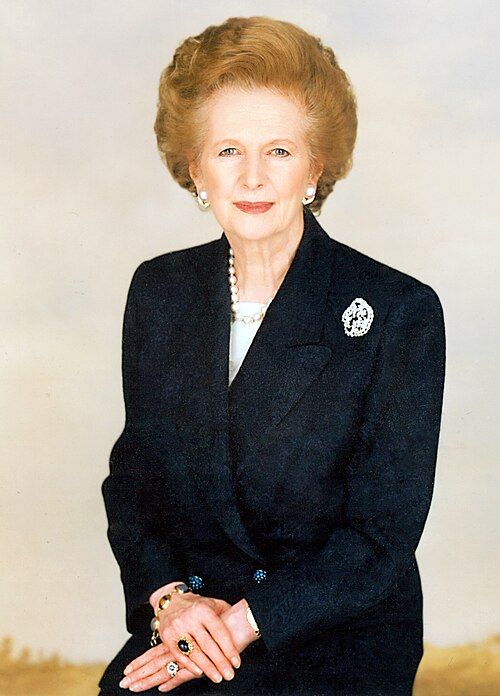
Margaret Hilda Thatcher (13 October 1925 – 8 April 2013) was a British stateswoman who served as Prime Minister of the United Kingdom from 1979 to 1990 and Leader of the Conservative Party from 1975 to 1990. She was the longest-serving British prime minister of the 20th century and the first woman to hold that office.
Thatcher was born into a grocer's family in Grantham, Lincolnshire. She studied chemistry at the University of Oxford, worked briefly as a research chemist, and later became a barrister. She was elected Member of Parliament for Finchley in 1959, and in 1970 she became Secretary of State for Education and Science, earning the nickname "Milk Snatcher" for abolishing free milk for primary school children. In 1975, she defeated Edward Heath to become Conservative Party leader.
After winning the 1979 general election, Thatcher implemented "Thatcherism"—economic policies centred on privatisation, tax cuts, deregulation, and curbing trade union power. She led Britain to victory in the 1982 Falklands War, which greatly boosted her popularity. In 1984, she signed the Sino-British Joint Declaration, confirming Hong Kong's return to China in 1997. That same year, she survived the Brighton hotel bombing and successfully overcame the 1984–85 miners' strike. In 1986, she introduced the financial "Big Bang" reforms.
During her third term, she pushed the unpopular Community Charge (poll tax) and became increasingly Eurosceptic, causing divisions within her party. In 1990, she resigned under pressure in a party leadership challenge and was succeeded by John Major. She left the House of Commons in 1992 and was granted a life peerage. Her health declined in later years, and she died of a stroke in London in 2013.
Thatcher was a highly controversial figure. Supporters praised her for revitalising the British economy and restoring national confidence, while critics accused her of deepening social divisions, causing unemployment, and deindustrialisation. Her political legacy continues to influence Britain and the world.
The Geng Metal Day Master is born in the Xu month. Fire and Earth are scorching; the Earthly Branches Wu and Xu combine to Fire, while Si Fire adds to it, causing the Officer and Killing stars (Guan Sha) to be excessively strong, leaving the Day Master (self) weak. The native is like metal being forged by fierce flames, constantly enduring external pressure and challenges, yet lacking inner flexibility. She must rely on the moisture of Water and Wood to cool and harmonize the chart. Her overall demeanor is resolute, decisive, and iron-fisted, but she can appear cold and rigid. Her greatest strength is the ability to exert leadership under immense pressure, while her challenge lies in emotional suppression and tension in relationships. The Bing Fire Qi Sha (Indirect Officer) appearing in the Month Pillar is like a sword hanging overhead, indicating that early environments or paternal influences brought a sense of urgency, forcing her to break through obstacles with sheer willpower.
This chart follows the 'Qi Sha Ge' (Indirect Officer Configuration), ideally handled by using Output (Shi Shang) to control the Qi Sha (Indirect Officer) or using Resource (Yin) to transform it. However, in this chart, the Resource stars are hidden without appearing, and the Output stars are weak. Thus, the only option is to use Jie Cai (Rob Wealth/Peer) to resist the Qi Sha (Indirect Officer), which is a variant of the 'Sha Ren Ge' (Killing Blade Configuration). The primary Yong Shen (Beneficial Element) is Water (Output stars), which subdues the overly strong Qi Sha, transforming aggressiveness into strategy and eloquence. Next favored is Wood (Wealth star), as Wood can generate Fire to drain Water and facilitate regeneration, but Wood is weak in the natal chart. Fire, Earth, and Metal are unfavorable: Fire intensifies the Killing tendency, Earth buries the Metal, and Metal competes for the Qi Sha (Indirect Officer), increasing rivalry. This configuration means that her life must be achieved through confrontation and competition, making her suited to rise in high-pressure, conflict-ridden environments. The reliance on Jie Cai indicates that she needed allies, teams, or tough methods—even at the cost of offending others—to advance her views, which manifested during her governance as the tough reforms of 'Thatcherism'.
Bing Fire Qi Sha appears in the Heavenly Stem, sitting on the Xu Earth store, and further rooted in Si Fire, creating a powerful 'Qi Sha Attacking the Day Master' scenario. Qi Sha represents pressure, authority, and challenge; attacking the self means her entire life was in a state of struggle, whether in parliamentary debates or policy implementation, she displayed aggression and an uncompromising attitude. The Hour Pillar Xin Metal Jie Cai appears, standing alongside the Geng Metal Day Master, forming a structure of 'Bi Jie (Brothers/Rivals) Resisting the Qi Sha (Indirect Officer)'. Jie Cai is assistance from peers but also symbolizes competition; this made her habitually confrontational, prone to creating enemies, yet also able to gain followers. The Month Branch Xu hides Ding Fire Zheng Guan (Zheng Guan (Direct Officer)), seen together with Bing Fire Qi Sha, constituting a 'Mixed Guan Sha' (Officer and Qi Sha (Indirect Officer) Mix). This caused her to swing between adhering to rules (Zheng Guan) and being driven by power to break them (Qi Sha), but ultimately she leaned toward forceful solutions. This also manifested in her marriage as a 'strong woman, weak man' dynamic. Her toughness, directness, and quick, ruthless decision-making all stem from this configuration of fire tempering metal.
The Day Branch Wu Fire is a 'Peach Blossom' (Charisma) and also carries the 'Jiang Xing' (Leadership Star). Peach Blossom endows her with personal magnetism and public appeal, while the Leadership Star reinforces her leadership ability, making her highly effective on the political stage of the media age and skilled at crafting her personal image. The Month Branch Xu and the Year Branch Chou both carry 'Hua Gai' (Solitude Star) and mutually punish each other. Hua Gai governs solitude and otherworldly thinking, while the punishment brings inner turmoil and external clashes. This is reflected in her frequent disagreements with Conservative Party colleagues and even cabinet members, and her aloofness in later years. The Hour Branch Si Fire is a 'Wang Shen' (Cunning/Peril Star). Wang Shen is associated with schemes and strategies but also hints at hidden risks. She faced many political crises (e.g., the IRA bombing) yet always emerged unscathed. The Tian Yi (Heavenly Noble) and Tian Yue De (Heavenly Moon Virtue) Gui Ren (Noble Stars) are present in the Year and Month Pillars, indicating that she always received protection from higher-ups or traditional forces and gained opportunities at critical moments. These Shen Sha weave a life journey full of dramatic tension: enjoying the loneliness of the spotlight while displaying extraordinary control in crises.
The Geng Metal Day Master is the 'metal of axes and halberds', strong and fierce with an inherent killer instinct. Sitting on the Wu Fire Zheng Guan (Zheng Guan (Direct Officer)) which forges the metal, the severity is further intensified. Her thinking pattern is like a tight logical machine, always emphasizing efficiency and results, while her emotional dimension is deeply suppressed. In everyday situations, she presents a calm, restrained mask, but under pressure she erupts with astonishing combativeness, like struck metal emitting a resonant sound. What she needs is not warmth but opponents and battlefields, confirming her self-worth through continuous conquest. This fundamental character allowed her to carve a path in the male-dominated political arena, yet it also made her appear rigid in interpersonal relations.
The greatest source of energy in the chart comes from the combination of Qi Sha (Indirect Officer) and Jie Cai (Rob Wealth/Peer), i.e., the fighting talent of 'using Peers to Resist the Qi Sha (Indirect Officer)'. This endows her with extraordinary willpower and strategic combativeness, enabling her to remain lucid under high pressure and quickly organize counterattacks. Her eloquence is not gentle persuasion but sharp debate and unquestionable assertion, which proved particularly lethal in parliamentary politics. Meanwhile, the Wu Fire, serving as both Jiang Xing (Leadership Star) and Peach Blossom (Charisma), gives her an instinct for manipulating public sentiment and an understanding of how to use the media to reinforce the 'Iron Lady' image. These talents propelled her to the pinnacle of power and allowed her to display remarkable leadership during crises (such as the early 1980s economic recession and the Falklands War).
The core conflict in the chart lies in the 'Mixed Guan Sha' (Officer and Qi Sha (Indirect Officer) Mix) and the 'Jie Cai Robs Wealth' dynamic. The mixed Guan Sha leads to an internal struggle between following rules (Zheng Guan) and being driven by the desire for power to break rules (Qi Sha). This contradiction meant that although she championed free markets, she implemented policies with a heavy hand. Jie Cai overcomes Wealth, harming the Yi Wood Wealth star. As a female leader, she continuously encroached upon traditional male politicians' territory; her fiscal policies tended toward austerity but also exacerbated social inequality. Her blind spot lies in overconfidence and rigidity, an unwillingness to compromise, which ultimately led to her being abandoned by the Conservative Party over issues like the Poll Tax—a negative manifestation of Jie Cai robbing wealth: allies turning into competitors.
The life of Margaret Thatcher is a life of fierce conflict between Metal and Fire, forged into a cutting edge. The chart's Qi Sha attacking the Day Master drew out her ferocity; the rely on Jie Cai allowed her to leverage forces effectively. With an iron fist, she transformed Britain, and with an unyielding attitude, she exited the stage. Her life trajectory exemplifies the typical traits of the 'Sha Ren Ge' (Killing Blade Configuration): rising in turbulent times, achieving success but retiring without the comfort of warmth. Her lonely later years fulfilled the Hua Gai star's prophecy, but history has carved her indelible mark—a stateswoman who rewrote the direction of her country through rhetoric and will.
The Da Yun features the Zheng Guan (Direct Officer) (Zheng Guan) emerging prominently in the Heavenly Stem and the Indirect Resource (Shi Shen) seated in the Earthly Branch, forming a structure where the Officer and Resource nurture each other. This decade marks the native's transition from childhood to adolescence. The Zheng Guan (Direct Officer) (Zheng Guan) embodies discipline and rules, while the Indirect Resource (Shi Shen) represents talent and expression. Their combination indicates that the native, in a favorable educational environment, gradually displays intelligence and leadership potential. She begins systematic education, enters Oxford University, laying the groundwork for her future political career. Overall, this is a decade of learning, accumulation, and building a knowledge foundation, the beginning of an upward trajectory.
The Zheng Guan (Direct Officer) (Zheng Guan) safeguards the Self, and the Indirect Resource (Shi Shen) generates Wealth (Cai), leading to notable academic achievements. Though her career has yet to unfold, academic fortune is robust. The Indirect Resource symbolizes talent, while the Zheng Guan (Direct Officer) represents standards and goals, enabling the native to be both creative and self-disciplined in her studies. She successfully gains admission to Oxford University's Chemistry program, earns scholarships, and lays the foundation for future social resource accumulation. No significant changes in wealth; primarily reliant on family support.
The Zheng Guan (Direct Officer) (Zheng Guan) serves as the Husband Star (Fu Xing), and the Indirect Resource (Shi Shen) represents expression, resulting in simple early-life relationships. During this decade, the native mostly interacts with family, classmates, and teachers. The Indirect Resource brings a gentle and outgoing personality, fostering good social connections, yet the Zheng Guan (Direct Officer)'s influence also maintains a sense of distance. In terms of family, her father has a significant impact, supporting her academic pursuits. No major marital events occur.
Metal (Jin) and Fire (Huo) clash; guard against respiratory issues. The natal chart has strong Metal and Fire. The Da Yun's Ding Fire (Huo) emerges prominently, intensifying Fire's assault on Metal. During youth and adolescence, energy is abundant, but attention must be paid to the health of the lungs, throat, and respiratory system. A balanced diet is advised, and overexertion should be avoided.
The Da Yun features the Indirect Resource (Pian Yin) generating the Self and the Hurting Officer (Shang Guan) venting brilliance, marking a decade of academic and life-direction transformation. The Indirect Resource (Pian Yin) represents advanced studies, while the Hurting Officer (Shang Guan) stands for innovation and breakthroughs. In this decade, the native completes her Oxford education and initially steps into society. She works for a chemical company, but quickly discovers an interest in politics. The Hurting Officer (Shang Guan) emboldens her to challenge tradition, and the Indirect Resource (Pian Yin) grants her the ability to delve deeply. Overall, this is a transitional period of exploring her life path and cementing her political aspirations.
The Hurting Officer (Shang Guan) generates Wealth (Cai), and she begins accumulating professional experience. After university, she joins a plastics company as a chemistry researcher. The Hurting Officer (Shang Guan) makes her dissatisfied with the status quo; she actively participates in local political activities and starts voicing political opinions. Financially, the job provides a stable income, but this is not her primary pursuit. In 1950, she loses her first parliamentary election bid, but gains valuable electoral experience.
The Hurting Officer (Shang Guan) carries Peach Blossom (Tao Hua; Romance/Charisma), leading to changes in romantic status. The Hurting Officer represents talent and romance. During this decade, she meets and falls in love with Denis Thatcher, marrying him in 1951. The Hurting Officer also signifies children; in 1953, she gives birth to twins. Marriage brings her support and stability, with her spouse providing substantial help. Meanwhile, the Hurting Officer (Shang Guan) makes her shine in social circles.
The Zi Water (Shui) Hurting Officer (Shang Guan) drains Metal (Jin), raising concerns about emotional fluctuations. The Da Yun's Earthly Branch Zi Water (Shui) is the Hurting Officer (Shang Guan); strong Water drains Metal, potentially leading to energy depletion. Additionally, Hurting Officer (Shang Guan) clashes with the Officer (Guan), possibly causing anxiety or rebellious tendencies. Maintaining a regular routine and tending to mental health is advised.
The Da Yun features a double layer of Direct Resource (Zheng Yin), a decade for solidifying the career foundation. Direct Resource (Zheng Yin) represents elders, support, and shelter. During this period, the native receives mentorship from influential figures within her party, steadily advancing. While caring for her family, she actively engages in political activities and is finally elected as a Member of Parliament (MP) in 1959. The Resource star (Yin) denotes absorption and accumulation; this decade is her phase of building political connections and mastering the rules. Overall, it is a preparatory period for professional ascent.
The Resource star (Yin) protects the Self, and her career begins to take off. The Direct Resource (Zheng Yin) brings a stable career development path. She runs multiple election campaigns; though defeats are frequent, each attempt garners more support. In 1959, she successfully wins a seat as an MP, entering Parliament, where she handles pension and national insurance affairs. Wealth-wise, the MP salary is steady, but the primary benefit is elevated social status.
The Direct Resource (Zheng Yin) is an auspicious star, leading to a harmonious family. During this period, family relations are stable; her husband supports her career, and her children grow healthily. The Resource star (Yin) also represents connections with elders; she receives guidance from senior party MPs such as Keith Joseph. Socially, she builds a reputation for diligence and frankness.
Excess Earth (Tu) buries Metal (Jin); pay attention to spleen and stomach digestion. The natal chart already has a bias toward strong Earth. The Da Yun sees Ji Chou, a double dose of Earth, which can bury Metal. Watch for digestive system issues, such as poor appetite or indigestion. Additionally, an overabundant Resource star (Yin) can lead to excessive rumination; appropriate exercise is recommended to keep Qi and blood flowing.
The Da Yun features the Companion (Bi Jian) aiding the Self and the Indirect Wealth (Pian Cai) in command, a decade of substantial career breakthroughs. The Companion (Bi Jian) represents peer competition and cooperation, while Indirect Wealth (Pian Cai) signifies unexpected gains and expansion. In this decade, the native's political standing markedly rises. In 1970, she becomes Secretary of State for Education and Science. Though the 'Milk Snatcher' incident causes controversy, it also displays her tough style. Indirect Wealth (Pian Cai) also means increased resources; she begins to formulate her own policy ideology. Overall, this is a phase of sharply growing power and responsibility.
The Companion (Bi Jian) divides wealth, while Indirect Wealth (Pian Cai) gains a strong footing; position and influence rise in tandem. In 1964, she becomes a member of the Conservative Shadow Cabinet, gradually entering the inner circle. In 1970, she takes the position of Education Secretary, her first cabinet portfolio. Indirect Wealth represents pioneering; she pushes for educational reforms, but the cancellation of free milk provokes protests, simultaneously showcasing her resolute political style. Financially, a cabinet minister's salary is higher, and she accumulates significant political capital.
The Companion (Bi Jian) overcomes Wealth (Cai), leading to competitive interpersonal dynamics. The Companion (Bi Jian) represents colleagues and peers. During this decade, she faces internal and external party competition; in particular, her relationship with party leader Edward Heath is delicate. Indirect Wealth (Pian Cai) generates Killing (Sha), she clashes intensely with opponents, gradually crafting the 'Iron Lady' image. At home, her husband's career is stable, children are growing up, and relations are positive.
Strong Metal (Jin) weakens Wood (Mu); pay attention to liver and gallbladder health. The Day Master Geng Metal (Jin) receives additional help from the Companion (Bi Jian), but Indirect Wealth Yin Wood (Mu) is suppressed by Metal. The liver and gallbladder correspond to the Wood element; emotional regulation is important. Avoid overwork that might trigger liver-gall discomfort. Get more rest and reduce late nights.
The Da Yun features the Rob Wealth (Jie Cai) merging with the Killing (Sha) and the Direct Wealth (Zheng Cai) generating the Officer (Guan), a decade reaching life's pinnacle. The Rob Wealth (Jie Cai) represents action force and rivalry, while Direct Wealth (Zheng Cai) represents stable income. In this decade, the native defeats internal party rivals and becomes leader of the Conservative Party (1975), then wins the 1979 general election to become the UK's first female prime minister. The Rob Wealth (Jie Cai) merges with the Killing (Sha) — Xin merges with Bing — neutralizing the restraint of the Qi Sha (Indirect Officer) (Qi Sha), allowing her to consolidate power. The Direct Wealth (Zheng Cai) generates the Officer (Guan), helping fortify her position. Overall, this is a qualitative shift from challenger to ruler.
Rob Wealth (Jie Cai) resists the Killing (Sha), Direct Wealth (Zheng Cai) supports the Officer (Guan); power reaches its zenith. In 1975, she successfully challenges party leader Edward Heath, becoming Conservative leader. In 1979, she leads the party to electoral victory and assumes the office of prime minister. Direct Wealth (Zheng Cai) generates Officer (Guan); she implements economic reforms (tax cuts, privatization), improving the nation's fiscal health. Rob Wealth (Jie Cai) helps the Self; she suppresses dissent within the party and is tough externally, as seen in the Falklands War. Wealth-wise, the prime ministerial compensation is generous, but as a statesperson, she pursues a historical legacy.
Rob Wealth (Jie Cai) dominates, leading to strained interpersonal relations. Rob Wealth (Jie Cai) signifies peer competition and conflict. During this decade, she frequently clashes with cabinet members, unions, and international counterparts. Her style is tough; she builds alliances with figures like Nixon and Reagan, but also experiences constant friction with the EU. At home, her husband Denis provides steadfast support; her children are independent.
Metal (Jin) and Wood (Mu) are at war; beware of sinew and bone injuries. The Xin Mao period features Metal and Wood clashing. Strong Metal weakens Wood, so there is a tendency toward aches in sinews and bones, and risk of external injury. With heavy work intensity, balance between work and rest is crucial to prevent exhaustion-induced heart problems.
The Da Yun features the Indirect Resource (Shi Shen) emerging prominently in the Heavenly Stem, and the Indirect Resource (Pian Yin) seated in the Earthly Branch, a decade where the career continues but begins to show signs of decline. The Indirect Resource (Shi Shen) represents output and reform, while the Indirect Resource (Pian Yin) stands for contemplation and change. During this decade, she continues serving as prime minister, pushing forward economic privatization, curbing unions, and signing the Sino-British Joint Declaration. However, the Indirect Resource (Shi Shen) controls the Killing (Sha), intensifying conflict with traditional elements within the party. The Indirect Resource (Pian Yin) also represents sudden upheavals. In 1990, she resigns under party pressure. Overall, this is a turning point where achievements and criticisms coexist.
Indirect Resource (Shi Shen) generates Wealth (Cai), but Indirect Resource (Pian Yin) snatches Resource (Yin); the career peaks then turns downhill. Indirect Resource (Shi Shen) signifies new policy ideas; she advances 'Thatcherite' reforms, and the economy continues to develop. Indirect Resource (Pian Yin) represents unconventional methods; she suppresses the miners' strike, reinforcing personal authority. She wins a third term in 1987, but after 1989, due to European policy disagreements, internal party challenges mount. Indirect Resource (Pian Yin) snatching Resource (Yin) indicates policy implementation hitting roadblocks; ultimately, she resigns after a leadership challenge in 1990. Financially, the prime ministerial salary is ample, but after resignation, income mainly comes from speeches and book royalties.
The Indirect Resource (Shi Shen) drains the Self, complicating interpersonal relationships. Indirect Resource (Shi Shen) makes her an eloquent public speaker, but Indirect Resource (Pian Yin) increases suspicion. Her relationship with the EU sours, while she stays close to the US. At home, her husband's health declines, and the children go their own ways. After resignation, she becomes distant from some party figures.
Water (Shui) and Earth (Tu) clash; pay attention to kidney and circulation. The Da Yun is Ren Chen, with strong Water and stifled Earth. The Day Master Geng Metal is drained by Water, so precautions against kidney and urinary system issues are needed. Emotionally, pressure may lead to depression; maintain optimism and moderate leisure.
The Da Yun features the Hurting Officer (Shang Guan) emerging prominently in the Heavenly Stem and the Qi Sha (Indirect Officer) (Qi Sha) seated in the Earthly Branch, a post-retirement decade where she remains active in the public sphere. The Hurting Officer (Shang Guan) represents speech and writing, while the Qi Sha (Indirect Officer) (Qi Sha) embody pressure and challenges. She writes memoirs, delivers speeches, and continues to influence politics. However, Hurting Officer (Shang Guan) seeing the Killings (Sha) also brings criticism and health problems. After leaving the House of Commons in 1992, she gradually retreats from core politics but remains a spiritual leader of the Conservative Party. Overall, this is a stage where influence endures while physical health wanes.
Hurting Officer (Shang Guan) generates Wealth (Cai); Qi Sha (Indirect Officer) (Qi Sha) attack the Self; income from publishing and speeches. She publishes several memoirs, including 'The Downing Street Years,' earning substantial royalties. The Hurting Officer (Shang Guan) is a display of talent; she meticulously curates her political legacy. The Qi Sha (Indirect Officer) (Qi Sha) represent public pressure; external evaluations of her legacy are polarized. Wealth-wise, copyright and speech income is considerable but less than in her prime.
Hurting Officer (Shang Guan) overcomes Officer (Guan); changes in family and external relationships. Hurting Officer overcoming Officer represents increased distance from officialdom. Tensions with successor Prime Minister John Major surface. The Qi Sha (Indirect Officer) (Qi Sha) represent petty antagonists; some former subordinates criticize her. At home, her husband passes away in 2003, a heavy blow. Her children are often by her side, but with advanced age, social circles shrink.
Water (Shui) and Fire (Huo) clash violently; watch cardiovascular and cerebrovascular health. Gui Water Hurting Officer (Shang Guan) overcomes Ding Fire Qi Sha (Indirect Officer) (Qi Sha), leading to disharmony between Water and Fire. During this decade, she experiences multiple minor strokes, with memory decline and energy markedly reduced. Strict diet control, regular check-ups, and avoidance of emotional excitement are advised.
The Da Yun features Indirect Wealth (Pian Cai) generating the Officer (Guan), and the Officer Star (Guan Xing) gaining a strong footing, a decade of late-life honor and life's final chapter. Indirect Wealth (Pian Cai) represents societal recognition and honors, while the Zheng Guan (Direct Officer) (Zheng Guan) stands for status and ceremony. In this decade, she receives numerous commemorative events, such as the film 'The Iron Lady,' but due to health reasons she gradually fades from public view. The Zheng Guan (Direct Officer) (Zheng Guan) being generated by Wealth (Cai) brings her many accolades, but an overabundant Officer Star also restricts her freedom. In 2013, she dies from a stroke. Overall, this is a decade of enjoying a peaceful retirement, with her merits and demerits left for posterity to judge.
Indirect Wealth (Pian Cai) generates the Officer (Guan); honors and royalties continue. She continues publishing books and participates in memorial activities. Indirect Wealth (Pian Cai) brings economic gains, such as film rights and lecture fees. However, her physical condition restricts activities; substantively, her career has ended. The Zheng Guan (Direct Officer) (Zheng Guan) brings her to official occasions, such as an invitation to 10 Downing Street in 2011. Wealth is ample, but in old age, health takes precedence.
The Zheng Guan (Direct Officer) (Zheng Guan) shapes her public image; family warmth endures. She maintains close ties with her children, and her daughter cares for her. The Zheng Guan (Direct Officer) (Zheng Guan) ensures continued respect, but illness reduces her social interactions. Her husband is deceased; she lives alone but has frequent visitors. After the film's release in 2011, public attention surges again.
With Fire (Huo) blazing and Earth (Tu) dry, be vigilant about stroke risk. The Da Yun is Jia Wu, with strong Fire overcoming Metal. Wu is the Officer Star (Guan Xing); intensifying Fire increases cardiovascular strain. She suffers multiple strokes and eventually succumbs. Maintain a calm mindset, avoiding excitement or grief.
The Children Palace is an empty palace with no main stars, while the opposite Property Palace has Tai Yang (Sun) and Tai Yin (Moon) Hua Ji (transforms into Adversity) shining into it. An empty palace represents weakness in this area or the need to rely on other palaces for support. The Children Palace is affected by Tai Yang and Tai Yin Hua Ji, leading to complex family relationships and possible emotional distance between the children and the mother. Thatcher had twins—son Mark and daughter Carol. Her political career consumed most of her time, resulting in a distant parent-child relationship, especially with son Mark, who repeatedly caused controversies (such as being arrested in 2014 for involvement in an arms deal), causing her distress. Tai Yang and Tai Yin Hua Ji suggest an imbalance of yin and yang in the family, specifically an imbalance between the paternal (Tai Yang) and maternal (Tai Yin) roles.
This palace has no Four Transformations, but the Property Palace's Tai Yin Hua Ji directly clashes with the Children Palace. Tai Yin Hua Ji primarily signifies the sacrifice and emotional debt of the mother (or female elder). As a female Prime Minister, Thatcher tilted heavily towards her career over family, often missing important moments in her children's growth due to busyness. Her daughter Carol once described her mother's emotional coldness towards her children in her autobiography. Hua Ji also manifests as negative public attention once the children become public figures, damaging the family reputation.
Thatcher had a strong desire for control and even tried to interfere in her children's lives. Son Mark once used his mother's fame for business activities and was embroiled in an arms deal scandal in South Africa in the 1990s, damaging Thatcher's reputation in her later years. Daughter Carol, relatively low-key, worked in media but remained distant from her mother. The empty palace combined with the clash of Hua Ji shows that children were not a source of enjoyment in the native's life but rather a source of responsibilities and worries. Thatcher treated her children much like she governed the country—emphasizing principles over emotions.
The Body Palace (Shen Palace) is here, with Lian Zhen (Integrity Star) in its thriving state, accompanied by Tuó Luó (Delay Star) in its waning state. Lian Zhen is a secondary Peach Blossom (Romance) star, its energy transforms into 'imprisonment', governing principles, fidelity, and legal troubles. Tuó Luó is a hidden consumption star, governing delays and entanglements. The combination of Lian Zhen and Tuó Luó in the Spouse Palace suggests that the native's marriage relationship is both deeply affectionate and persistent, yet also carries coldness and loneliness. After marriage, Thatcher and her husband Denis Thatcher had a stable relationship; Denis fully supported her political career, but their way of getting along was not tenderly affectionate, but based on understanding and responsibility. Lian Zhen's imprisoning nature also manifested in Thatcher's marital fidelity; she refused extramarital affairs and focused on balancing family and career.
There is no Four Transformations (Si Hua) in this palace, but the presence of the Body Palace here reinforces the native's emphasis on marriage. Thatcher's marriage was not only an emotional anchor but also a political asset. Denis was a successful businessman who provided her with financial backing and emotional support. However, Tuó Luó in its waning state also hints at forbearance in the marriage — Thatcher was long preoccupied with state affairs, and Denis's health declined in later years; during her prime ministership, she had to balance caring for her husband, a pressure difficult for outsiders to imagine. Lian Zhen in its thriving state enabled her to maintain a dignified image in public, attending events hand in hand with her husband, symbolizing traditional family values.
Margaret Thatcher married Denis Thatcher in 1951; Denis was ten years older and had a steady personality. After marriage, Thatcher quickly gave birth to twins, but she did not abandon her political ambitions, and with her husband's support, she moved step by step toward the pinnacle of power. Denis once jokingly called himself 'the world's most famous unknown person.' However, the effect of Tuó Luó in waning state manifested in later years: Denis suffered from heart disease, and after resigning in 1990, Thatcher spent more time with him, but after Denis passed away in 2003, Thatcher fell into deep loneliness and declining health. The persistence of Lian Zhen in thriving state kept her from remarrying, as she held fast to her husband's memory. The Spouse Palace also reflects Thatcher's demands on allies: she had a tacit understanding with U.S. President Reagan, regarding him as a 'political companion,' but often clashed with other European leaders due to her tough stance, which aligns with the principle-first trait brought by Lian Zhen's imprisoning energy.
Qi Sha (Indirect Officer / Warrior Star) in a prosperous state sits in the Wealth Palace, meeting Tian Kui (Nobleman Star). Qi Sha is a star of generalship, representing change and pioneering. Prosperous Qi Sha in the Wealth Palace implies that the native acquires wealth through competition, risk-taking, and pioneering, rather than favoring stable income. Tian Kui is a star of helpful people, indicating that the path to wealth often receives help from benefactors. Thatcher's wealth primarily came from inheriting her husband's business and her income from speeches and writing, not from her political salary. Prosperous Qi Sha also symbolizes her innate business acumen—she helped in a grocery store, learning bookkeeping and pricing; later, as Prime Minister, she was extremely sensitive to fiscal budgets and implemented policies to control inflation and cut taxes.
This palace has no Four Transformations, but the Travel Palace has Zi Wei (Emperor Star) Hua Ke (transforms into Reputation) illuminating the Wealth Palace, forming a configuration where the Ke star shines upon it. Zi Wei Hua Ke brings fame and professional recognition, which then translates into wealth. In her later years, Thatcher earned substantial income through publishing memoirs and global speeches, precisely reflecting the effect of Zi Wei Hua Ke: benefiting from status and reputation. Qi Sha's decisive character kept her active in the business world after retirement, serving as an advisor to multiple companies and gaining economic returns through connections (Tian Kui).
Thatcher came from a family of small businessmen, not from great wealth. She completed her Oxford education on a scholarship, and after marriage, her husband's wealth allowed her to enter politics without financial worries. During her premiership, she strictly limited government expenses and significantly reduced the top tax rate. These policies reflected her personal views on wealth—opposing excessive welfare and encouraging prosperity through hard work—and matched the competence of prosperous Qi Sha. After retirement, she accumulated considerable assets through speeches (tens of thousands of dollars each) and royalties from her book ('The Downing Street Years'), but spent a lot on health issues in her later years. Prosperous Qi Sha indicates that she had control over money and did not blindly follow others, while Tian Kui corresponds to her good relationships with business elites.
Tian Liang (Healing Star) Hua Quan (transforms into Authority) in the Health Palace, accompanied by Zuo Fu (Left Assistant) and Tian Ma (Heavenly Horse). Tian Liang is a protective star; Hua Quan enhances its control and adjustment abilities. Zuo Fu represents assistance, while Tian Ma indicates constant travel/toil. This combination suggests that although the native has a strong constitution, overwork and frequent travel lead to accumulated fatigue and illness. Thatcher was known for her high energy, sleeping only four to five hours a day, but long-term high-intensity work led to multiple strokes and health deterioration. Tian Liang Hua Quan also endowed her with strong recovery ability—after several minor strokes, she could still make public appearances, but eventually suffered cognitive decline (senile dementia) in her later years.
Tian Liang Hua Quan in the Health Palace signifies outstanding self-regulation and disease resistance. Thatcher survived the 1984 Brighton bombing, clearly demonstrating Tian Liang's protective effect. However, Hua Quan also means that excessive stress directly impacts health. She suffered multiple strokes in her later years and nearly lost the ability to speak after 2002, which is related to the over-consumption of Tian Liang Hua Quan—power made her continuously overdraw her body. Tian Ma corresponds to her frequent domestic and international travels, aggravating her physical and mental burdens.
During her tenure, Thatcher's health record was acceptable, with only one migraine attack in 1979. But after resigning in 1990, her health deteriorated rapidly: she experienced transient amnesia in 1995, two strokes in 2001, and in 2002 doctors advised her to withdraw from public life. The positive effect of Tian Liang Hua Quan was that she was more resilient to stress than ordinary people; the negative was ignoring bodily signals. Zuo Fu symbolizes the presence of family caregivers in her later years, but Tian Ma indicates she still tried to participate in activities (her last public speech in 2005), unwilling to stop. Ultimately, 'senile dementia' (brain degeneration), ruled by Tian Liang, marked the endpoint of her life, confirming the excessive self-regulation and imbalance caused by Hua Quan.
In the Qian Yi Gong (Migration Palace), Zi Wei (Emperor Star) receives Hua Ke (Transformation of Ke), and Tian Xiang (Seal Star) is in conjunction. Zi Wei is the Emperor Star, governing status and image; with Hua Ke it adds to prestige. Tian Xiang is the Seal Star, governing coordination and support. The Qian Yi Gong is the space where the native manifests externally and develops; the combination of Zi Wei and Tian Xiang means that the native naturally exudes a leadership aura when going out, easily earning respect and promotion, and is adept at presenting a composed and elegant image in public settings. On the international stage beyond the UK, especially during the Cold War in her interactions with US President Reagan and Soviet leader Gorbachev, Thatcher displayed the demeanor of a major power leader, neither servile nor overbearing. Zi Wei Hua Ke led her to be seen as one of the "leaders of the free world." Tian Xiang assisted her in maintaining basic etiquette and rules in diplomacy, not losing grace even with a tough stance.
Zi Wei Hua Ke in the Qian Yi Gong directly strengthens opportunities and reputation for overseas development. Thatcher's diplomatic achievements owed much to Hua Ke: her visits to the US, Soviet Union, China, etc., were met with head-of-state-level reception, and her speeches (such as the birth of the "Iron Lady" in 1976) spread worldwide through the media, becoming a personal brand. Hua Ke also lent international influence to her political ideas; the Reagan administration's economic policies were deeply influenced by her supply-side thinking. The Qian Yi Gong as an outward stage, Zi Wei Hua Ke was key to Thatcher becoming a global political symbol.
Thatcher traveled little in her youth, but after becoming Prime Minister, she made frequent overseas visits. Her special relationship with the United States was the most prominent — during the Falklands War in 1982, the US provided critical intelligence and support; she had a close personal friendship with the Reagans. She also valued contact with China, visiting Beijing before the signing of the Sino-British Joint Declaration in 1984, displaying a negotiation style that was both tough and pragmatic. Tian Xiang's coordinating function allowed her to navigate different cultures with ease, but Zi Wei's authority also kept her always maintaining a posture of British interests above all. The Qian Yi Gong also reflects her activities abroad in later years: after retirement, she gave many speeches in the US, even considered moving there, but ultimately did not. Overall, Qian Yi Gong's Zi Wei Hua Ke is the core palace for her expansion of international standing and political legacy.
In the Nu Pu Gong (Colleagues Palace), Tian Ji (Wisdom Star) is at Wang (Prosperous) and Hua Lu (Transformed into Lu), Ju Men (Talkative Star) is at Miao (Peak), and they meet Wen Qu (Literary Star) at Miao (Peak). Tian Ji Hua Lu signifies adaptability, intelligence, and smooth interpersonal connections; Ju Men governs eloquence and covert alliances; Wen Qu represents literary talent. This palace concentrates stars of communication and wisdom, indicating that the native is adept at rhetoric and strategy in relationships, and can obtain information and support through social networks. As leader of the Conservative Party, Thatcher was highly skilled at using the media and party factions. Her speaking style was clear and forceful, with Ju Men at Miao allowing her to express opinions incisively, while Wen Qu at Miao endowed her with elegant rhetoric. Tian Ji Hua Lu implies that she gathered a group of advisors around her, such as economic advisor Keith Joseph, who provided theoretical bases for her policies.
Tian Ji Hua Lu falls in the Nu Pu Gong, indicating that subordinates or friends bring substantial help and flowing resources. During Thatcher's tenure, there were many officials in the cabinet who faithfully implemented her policies (such as Geoffrey Howe), but later, due to European policy disagreements, she fell out with some core members, revealing Ju Men's trait of covert conflict. Tian Ji Hua Lu also enabled her to flexibly court various party factions before coming to power; her defeat of Heath in 1975 to become party leader was precisely the result of her networking. Wen Qu at Miao corresponds to her relationships with the literary and journalistic circles; she was adept at using the media to promote her political ideas.
In her early career, Thatcher lacked a base within the Conservative Party, but she gradually built connections through roles such as Secretary of State for Education. The Hua Lu in the Nu Pu Gong attracted a group of loyal followers, such as Norman Tebbit. However, Ju Men at Miao also brought verbal disputes: her falling out with Foreign Secretary Geoffrey Howe over the European Monetary Union, which ultimately led to Howe's resignation in 1990 and triggered an internal challenge, becoming the trigger for her downfall. Wen Qu at Miao was reflected in her writing memoirs after retirement, collaborating with writers to publish. Additionally, her personal friendship with Reagan also falls under the Nu Pu Gong; though Reagan was not a subordinate, as an international ally, he provided significant support. Overall, Tian Ji Hua Lu in the Nu Pu Gong was the core driving force of her political operations, but Ju Men at Miao also planted the seeds of later betrayal.
The Siblings Palace contains You Bi (Right Assistant Star), Lucun (Salary Star), and Ling Xing (Fire Star). You Bi is an auxiliary star, indicating much help from siblings and friends; Lucun is a wealth storage star, suggesting harmonious sibling relationships that bring material support; but Ling Xing is a fire baleful star, hinting at latent conflicts or competition. Overall, sibling relationships are both intimate and hiddenly frictional. Thatcher had an older sister; their relationship was not particularly close, but in the family background, her father's influence far outweighed that of her peers. The presence of Ling Xing reflects Thatcher's competitive consciousness with peers during her growth, especially after entering Oxford University, as she strove to prove herself in a male-dominated political circle.
There is no Four Transformations in this palace, but the Siblings Palace is not directly activated by any Four Transformation. Thatcher's siblings did not directly help her politically, but You Bi and Lucun symbolize the emotional nourishment and stable upbringing she received from her family. Her father, a grocer and local councilor, was crucial to her early political enlightenment, which can be seen as a projection of You Bi's helpful mentor influence from the Siblings Palace. Ling Xing corresponds to the competition and exclusion she faced early on within the local Conservative Party.
Margaret Thatcher had only one older sister, not far apart in age, but her sister had a gentler character, contrasting with Thatcher's tough style. Her father was her spiritual mentor, while her mother was more traditional. The combination in the Siblings Palace suggests that the family was not entirely harmonious — Thatcher once recalled that her mother lacked support for her, which may correspond to the hidden conflict of Ling Xing. However, You Bi and Lucun ensured that she grew up in a materially comfortable middle-class family, allowing her to receive a good education (Chemistry at Oxford University), laying the foundation for her future political career. The Siblings Palace also represents close colleagues: in her early governance, capable assistants like William Whitelaw were akin to 'You Bi'-type partners.
Po Jun (Revolution Star) in its thriving degree sits in the Destiny Palace, accompanied by the baleful stars Di Jie (Earth Calamity) and Qing Yang (Horn Star). Po Jun is a consumption star, governing pioneering, destruction, and innovation; its thriving position makes it full of momentum, but Di Jie and Qing Yang bring radicalism, solitary courage, and turmoil. This combination indicates that the native will experience multiple rounds of creative destruction throughout life, often propelled in a tough, even ruthless manner. Thatcher's privatization and welfare cuts in the UK offended many traditional forces, but precisely because Po Jun's energy transforms into 'consumption,' she did not care about short-term sacrifices, only pursuing her goals. Qing Yang in the Destiny Palace also endowed her with strong action power and aggressiveness, making the title 'Iron Lady' a natural fit.
There is no Four Transformation in this palace, but the Destiny Palace borrows the light of Zi Wei (Emperor Star) transforming to Ke (Fame) from the Travel Palace. Zi Wei transforming to Ke bestows upon the native a natural leadership aura and discursive authority. Thatcher always presented a confident, clear image in public, never showing weakness even in the face of opposition. This Ke light makes her words and actions seem weighty, not merely extreme. The impact of Po Jun and Qing Yang in the Destiny Palace, packaged by Zi Wei's Ke, becomes a positive label of 'determined reform.'
The pattern of Po Jun seated in the Destiny Palace directly maps onto the tone of Thatcher's entire political career: she was not a guardian of the status quo but a destroyer and rebuilder of norms. Early as Conservative Party leader, she was known for challenging the party establishment and reshaping ideology. After taking office in 1979, she carried out bold economic reforms, closing loss-making state-owned enterprises and suppressing union power, causing great social turmoil, but she never wavered. This 'break-then-establish' destiny exactly explains why she could stand out in British politics, achieving both premiership and leaving behind great controversy. Di Jie in the Destiny Palace symbolizes the ups and downs in her political path — approval plummeted when unemployment spiked in 1981, but miraculously recovered after the Falklands War victory in 1982. Qing Yang corresponds to her multiple encounters with assassination threats (such as the 1984 Brighton bombing), but she always escaped danger.
Tian Tong (exalted) and Wen Chang (exalted) in the Parents Palace. Tian Tong is a star of blessings, governing kindness and harmony; Wen Chang is a star of literature, governing scholarship and academic success. With Tian Tong exalted in the Parents Palace, it indicates harmonious parental relationships and a gentle family atmosphere; Wen Chang exalted suggests that parents valued education or possessed cultural refinement. In fact, Thatcher's parents were open-minded; her father, in particular, encouraged her to read political books and participate in debates, and sent her to Oxford University. Tian Tong exalted also reflects her father's easygoing nature, while her mother, though reserved, was not harsh. Wen Chang exalted corresponds to her father's enthusiasm for local affairs, serving as town councilor and mayor, which directly inspired Thatcher's political ambitions.
There are no Four Transformations in this palace, but the auspicious combination of Tian Tong and Wen Chang in the Parents Palace provided the native with a good foundational education and social starting point. From her father, Thatcher learned speechmaking skills, a sense of responsibility, and conservative values. Tian Tong exalted created a supportive if not wealthy home atmosphere, while Wen Chang gave her the intellectual foundation for Oxford. The Parents Palace also represents superiors or elders; early in her political career, she received mentoring from senior Conservative MPs like John Wood, which aligns with the auspicious sign of scholarly success from Wen Chang exalted.
Thatcher's father Alfred had a profound influence on her. A grocer by trade, he was passionate about local politics and served as Mayor of Grantham. He taught her to "never follow the crowd," which became her life motto. Her mother, though not directly involved in politics, managed the household and supported her husband and daughter. Tian Tong exalted in the Parents Palace indicates her close bond with her father and a mild but dependent relationship with her mother. Wen Chang exalted corresponds to her winning a scholarship to study chemistry at Oxford, joining the Conservative Association, and distinguishing herself in political debates. Her parents' upbringing laid the foundation for her future dominance in politics.
Wu Qu (flourishing) and Tian Fu (flourishing) in the Fortune Palace, meeting Di Kong. Wu Qu is a wealth star, Tian Fu is a treasury star; together they indicate composure, pragmatism, and decisiveness. Di Kong brings spiritual emptiness and a breakthrough from traditional values. Wu Qu and Tian Fu flourishing represent a strong inner self, seeking material order; Di Kong allows for unconventional thinking. Thatcher's inner world was firm and rational; she believed deeply in free markets and individualism, instilled by her father's teachings from a young age. Di Kong gave her an independent spirit that refused to follow the crowd, enabling her to challenge mainstream opinion and implement controversial policies.
There are no Four Transformations here, but as the spiritual palace, Wu Qu and Tian Fu flourishing with Di Kong indicates substantial blessings but accompanied by loneliness. Wu Qu and Tian Fu signify both fortune and longevity; Thatcher lived to 87, with a long life despite illness in later years. Di Kong allowed her to enjoy solitude on a spiritual level; she once mentioned in her memoirs that she liked to contemplate policy alone at Chequers. Additionally, the flourishing nature of the Fortune Palace symbolizes that she never doubted her decisions internally, which was the source of her ability to withstand immense pressure.
Thatcher's mental core can be described as an "iron will." Her ideals and convictions were extremely firm; even in the face of collective opposition from cabinet members, she persisted in implementing the poll tax (community charge). The Wu Qu and Tian Fu combination gave her a natural sense of control over economic affairs, and she often said, "There is no alternative." The Di Kong star manifested in her political philosophy—she broke free from traditional Conservative consensus and pioneered Thatcherism. In her later years, though she lost power, she did not become despondent inside and remained active in international affairs, in keeping with the flourishing Fortune Palace.
In the Guan Lu Gong (Career Palace), Tan Lang (Desire/Social Star) is at Ping (Level), meeting Tian Yue (Assistant Star) and Huo Xing (Fire Star) at Xian (Fallen). Tan Lang is the Peach Blossom Star (Charisma/Romance) and Social Star; being at Ping indicates that career requires leveraging interpersonal relationships and adaptability. Tian Yue is the Mentor Star; Huo Xing at Fallen brings sudden conflicts and explosive force. The combination of Tan Lang and Huo Xing is known as the "Huo-Tan Pattern," which, if prosperous, can lead to sudden wealth, but being at Ping/Xian means career achievements come through intense competition and dangers, ultimately reaching heights through personal charisma and the support of mentors. Thatcher's political rise was not smooth; she faced many electoral setbacks, but after each crisis, she bounced back. The fallen Huo Xing trait corresponds to her bold risk-taking in the Falklands War in 1982, a victory that greatly consolidated her power.
There are no Four Transformations in this palace, but Wu Qu (Finance Star) and Tian Fu (Treasury Star) from the Fu De Gong (Fortune Palace) shine upon the Guan Lu Gong, providing steady financial support and decision-making ability. Wu Qu and Tian Fu transform into a wealth treasury, indicating that her career always revolves around economic issues and her decisions are pragmatic. Thatcher's economic policies (monetarism, privatization) exemplify Wu Qu's nature of precise calculation. Tian Yue represents the mentor in her career — such as Queen Elizabeth II, who, though politically neutral, showed respect for her tenure and appointed her Prime Minister in 1979. The adventurous spirit of Huo Xing at Fallen is also evident in her career: she persisted in sending troops to Argentina despite opposition, and the eventual victory in the Falklands War became her most glorious political moment.
Thatcher's Career Palace with Tan Lang at Ping and Huo Xing at Fallen describes a politician who rose to the pinnacle of power through unconventional means. In 1959, she was first elected as an MP, and later served as Parliamentary Undersecretary at the Ministry of Pensions, Secretary of State for Education, etc. In the 1975 party leadership election, she defeated former Prime Minister Heath, an unexpected upset. After winning the 1979 general election, she became the UK's first female Prime Minister. Tan Lang's social ability allowed her to balance different factions within the party, but Huo Xing's explosive force also led to frequent fierce arguments with cabinet ministers. In the mid-1980s, her implementation of the Poll Tax policy triggered massive protests, reflecting the danger of Huo Xing at Fallen; in 1990, she was forced to resign due to policy disputes and challenges within the party, also a portrayal of the dramatic ups and downs of Tan Lang at Ping. Tian Yue's role as a mentor included the support she received from many Conservative Party elders, but she also lost their support later due to her own obstinacy.
Tai Yang attained and Tai Yin does not transform into Avoidance in the Property Palace, with no auxiliary stars. Tai Yang governs father and brightness; Tai Yin governs mother and family. With Tai Yang attained but Tai Yin transforming into Avoidance, it forms the pattern of Sun and Moon reversed with Avoidance, indicating a family environment where the father's role was prominent while the mother's was lacking, and the home was often unstable or emotionally deficient. Thatcher's father had a huge influence on her political views, while her mother seemed distant. The Avoidance transformation also reflects that she sacrificed family time in balancing family and career, resulting in a cold family atmosphere in her later years. The Property Palace also represents real estate; although she had fixed residences, her busy work schedule gave her a weak sense of belonging at home.
With Tai Yin transforming into Avoidance in the Property Palace, it directly impacts family emotions and female elders. Thatcher's mother was introverted and rarely encouraged her, which she mentioned in her autobiography. The Avoidance transformation also strained her relationship with her daughter. Tai Yang attained but with no auxiliary stars indicates that although her father was good, he left no substantial property; the grocery store run by her parents did not bring her a large inheritance. In her later years, she gave her country house to her children and lived in a London apartment, with some disarray in property management.
Thatcher was born in an apartment above the shop in Grantham, where home and business were combined. Her father Alfred Roberts was a politically active grocer, while her mother Beatrice managed the household. Tai Yang attained shows that her father was her spiritual sunshine, inspiring her political path; Tai Yin transforming into Avoidance suggests that her mother provided limited emotional nourishment. This family background shaped Thatcher's competitive and combative character. After marriage, she and her husband Denis purchased multiple properties, but due to her work she lived mostly at 10 Downing Street or Chequers. After retiring, she moved to a residence in the Belgravia area of London, but the Tai Yin Avoidance led to loneliness in her later years in an empty home. Her children also seldom visited. The Avoidance transformation in the Property Palace symbolizes a lack of warmth in her family circle.
Generate your personal chart in under a minute. Sign up free and get 30 credits — enough for two or more AI readings. No credit card.
Generate my free BaZi chartPlease sign in to join the discussion
Sign In