Year
Ding
Mao
Qi Sha
Pian Cai
Hidden Stems
Yi (Pian)
- Star Luck
- Jue
- Sitting Branch
- Bing
- Void
- Xu-Hai
- Na Yin (Elemental Sound)
- Lu Zhong Huo
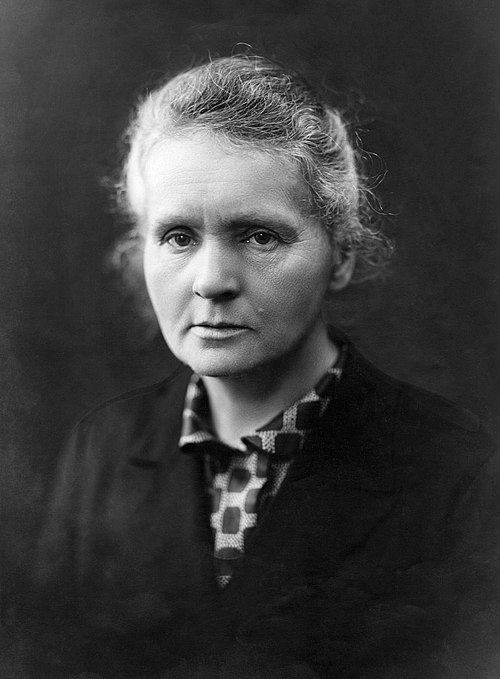
Marie Curie (born Maria Salomea Skłodowska; 7 November 1867 – 4 July 1934) was a Polish-born French physicist and chemist. A pioneer in radioactivity research, she is renowned for the discovery of radioactivity. Born in Warsaw, Poland, she studied at the clandestine Flying University in Warsaw before moving to Paris in 1891 to further her education. In 1895, she married Pierre Curie. Together, they researched radioactivity and discovered two new elements, polonium and radium. In 1903, the Curies and Henri Becquerel shared the Nobel Prize in Physics for their research on radioactivity, making Marie Curie the first woman to win a Nobel Prize. After Pierre's death in 1906, she succeeded him in his professorship and became the first female professor at the University of Paris. In 1911, she was awarded the Nobel Prize in Chemistry for isolating pure radium and studying its properties and compounds, becoming the first person to win two Nobel Prizes. During World War I, she developed mobile X-ray units and trained operators to provide medical aid to soldiers at the front. After the war, she helped establish the Curie Institute in Paris (1920) and the Curie Institute in Warsaw (1932), continuing her research on radioactivity. Her work laid the foundations for nuclear physics and cancer radiotherapy. In her later years, she suffered from aplastic anemia due to prolonged radiation exposure and passed away in 1934. Her life was also marked by public controversy over her relationship with physicist Paul Langevin, though it did not affect her scientific reputation.
Day Master Xin Metal, born in Xu month, weak body with strong Indirect Officer, wealth abundant but body weak, dry earth buries metal. Marie Curie was born on November 7, 1867, right after Frost's Descent and before the Start of Winter, in deep autumn. The month pillar is Xu earth in command, but Xu is a fire storage and dry earth, hiding Ding fire (Indirect Officer), with weak ability to generate metal. The Day Master Xin Metal is like a candle flame of metal in late autumn; flanked by two Mao branches (Indirect Wealth) draining it, and the hour pillar Jia Wu (Wealth generating Indirect Officer) further empowering the Officer; the year and month have Ding fire Indirect Officer prominently showing, directly attacking the Day Master. This forms a situation of Wood, Fire, and Metal conflicting, with dry earth unable to generate metal. Even more seriously, the chart completely lacks water, the Five Elements are severely unbalanced, which makes her overall energy state exhibit a quality of "fragile yet stubborn" — outwardly appearing delicate, but inwardly forged by the Indirect Officer into extreme tenacity. Her overall impression is one of quiet reserve and clear purpose, like a piece of metal repeatedly scorched by intense fire, enduring severe tempering yet refined to astonishing purity. The greatest advantage of this energy state is extraordinary stress tolerance and focus; the more pressure, the more her potential is unleashed. The biggest potential challenge is excessive physical depletion; the Indirect Officer attacking the body is like a blade at her back, keeping her in a constant state of tension, with deeply buried health hazards, just as she endured radioactive exposure throughout her life, ultimately paying with her life to illuminate the halls of science.
Indirect Officer pattern prominently appearing, Officer and Resource mutually generating; Useful Gods are Earth and Metal, Annoying Gods are Wood and Fire. The month branch is Xu earth, the hidden stems contain Wu (earth), Ding (fire), and Xin (metal). Wu earth (Direct Resource) is the primary qi, but Ding fire (Indirect Officer) also appears in the year stem, so the pattern can be classified as Indirect Officer pattern. With a weak Day Master and rampant Indirect Officer, this is inherently dangerous, but fortunately the month branch Resource star transforms the Officer, forming the noble pattern of "Officer and Resource Mutual Generation" — this pattern is like a fierce tiger being reined in, capable of transforming the destructive power of the Indirect Officer into pioneering drive. Hence, chart natives often achieve extraordinary accomplishments in harsh environments. Here, the Useful Gods are Earth and Metal: Earth (Resource) represents knowledge, mentors, and reputation, serving as the channel to resolve pressure into achievement; Metal (Companion) represents peers and supporters, helping her resist external adversaries. The Annoying Gods are Wood and Fire: Wood is Wealth star, Fire is Officer and Indirect Officer; Wealth colluding with Officer multiplies pressure, and Wood also overcomes the Useful God Resource, triggering conflicts. Madame Curie's life choices and achievements perfectly affirm this pattern: she pursued education from Poland to Paris, relying on the educational resources symbolized by "Resource"; she toiled in a rudimentary Sorbonne laboratory to extract radium for decades, converting the myriad difficulties of "Officer" into the glory of two Nobel Prizes. Her husband Pierre Curie was the embodiment of the month stem Geng metal (Rob Wealth), fighting alongside her to shoulder the weight of science. However, the rampage of the Annoying Gods Wood and Fire also kept her in long-term poverty (weak body cannot bear wealth) and health threats, even claiming her life — this is the inherent contradiction of the pattern.
Wealth and Officer attacking the body, Rob Wealth assisting the body, Wealth and Resource clashing, Wood strong Metal chipped. The most prominent Shi Shen relationships in the chart are: the year and hour Ding and Wu Indirect Officers clamp the Day Master; the month and hour Jia and Wu, and the year and day Mao Wood Wealth stars give full force to generate Officer, forming the inauspicious configuration of "Wealth Nourishing the Weak Officer". This represents an unending stream of external pressure, often tied to material and financial concerns. She worked most of her life in humble material conditions, but being weak and unable to bear wealth, even when discovering priceless radium, she chose to forgo patents and open the technology — a manifestation of "Wealth Star Damaging Resource": she refused to let money (Wealth) corrupt academic pursuit (Resource). On the other hand, the month stem Geng metal Rob Wealth appears; though Xu earth's dryness gives little help to metal, it still serves as same-element support, forming the auxiliary structure of "Rob Wealth Merging with Officer", ensuring that she always had like-minded companions (husband, sister) to share the struggle and pressure. This combination shaped her fundamental character of solitude without isolation, resilience tinged with tragedy. In decision-making style, she was extremely pragmatic and persistent; once a goal was set, she ignored all obstacles. In interpersonal patterns, she was not adept at mundane socializing, yet could form deep bonds with a few confidants, jointly resisting fate. Her career choice — radioactive research — was essentially the perilous realm of "Indirect Officer", but with the help of "Rob Wealth" and the intellect of "Resource Star", she forcibly extracted glory from it.
Year and Day General Star with Flowing Rosy Clouds; Hour Pillar Heavenly Noble meets Void; Month meets Ram Edge; Mao-Xu combine to Fire; Mao-Mao Self-Punishment. Shen Sha and punishment-combination relationships deepen the chart's drama. Both the year branch Mao and the day branch Mao are General Stars, endowing her with the courage to lead a team and indomitable leadership, making her undoubtedly the soul of her research team. However, the accompanying Flowing Rosy Clouds malignity foretold accidental bloodshed and bodily harm — the fatal damage of radiation to her blood is hinted at here with a sense of predestination. The hour pillar Jia Wu (Wu fire) is both Heavenly Noble and Indirect Officer, meaning her benefactors often also brought immense pressure, likely pointing to mentors or academic supporters who helped her yet pushed her deeper into danger. The Wu fire also falls under Void, suggesting that this benefactor influence was sometimes elusive; in her later years, though world-renowned, she still felt spiritual loneliness, and there was a sense of unfulfillment regarding children or achievements. The month branch Xu is Ram Edge, representing a fierce, radical personality, acting without leaving a retreat. Regarding earthly branches: Mao-Xu combine to Fire, transforming the month pillar Zheng Guan (Direct Officer) into the fire of Indirect Officer, harming the Husband Star, and indeed her husband died early in a traffic accident; the Officer transforming into Indirect Officer also aggravated her own health burdens. The two Mao branches self-punish, indicating frequent inner conflicts; she had to heed the call of scientific light yet could not ignore the body's lament — a self-tearing that persisted throughout her life.
Xin Metal yin natured, preferring moisture and disliking dryness; Indirect Officer bears down, introverted yet firm. The Day Master Xin Metal, in heaven it is frost, on earth it is jewelry — in essence, a fine, perceptive, perfection-seeking metal. Marie Curie's Xin Metal, born in Xu month, with dry earth that does not generate but buries, and lacking Ren water to moisten, gives her personality a quality of aloofness and cold solitude, like a cold blade surrounded by fire — outwardly minimal and calm, inwardly roiling with lava-like passion. Her thinking pattern was highly precise, adept at capturing the faintest radioactive glow from messy ores, just as a jeweler discerns the tiniest flaw; her emotional needs were drawn inward by the enveloping Resource star, making it difficult for ordinary people to enter her world, as she poured her deepest love into scientific truth. Under pressure, she displayed a typical Indirect Officer response — the more setbacks, the braver; unyielding. A crude shed, tons of pitchblende, lethal radiation — all spurred her desire to prove herself. But in comfort zones, she might feel lost; without a clear goal, the anxiety of being scorched by "Fire" would surface. That is why she could never rest, until she collapsed at her lab bench.
Resource star transforms Officer into authority; Indirect Officer forges courage; Rob Wealth bestows collaborative ability. The most shining talent in Madame Curie's chart comes from the energy of the Resource star Earth. Resource represents absorption, transformation, and accumulation, so she possessed extraordinary learning ability and memory, able to devour vast knowledge and make it her own — directly fueling her cross-disciplinary success in physics and chemistry. Secondly, the Indirect Officer Ding Fire, though an Annoying God, was tamed by the month pillar Resource into "martial authority", granting her the courage to break through countless difficulties; the feat of extracting new elements from unpromising pitchblende exemplifies "Indirect Officer being controlled". Thirdly, the Rob Wealth Geng Metal, though weak, was a crucial supporting force, representing her ability to unite a team, leveraging the intellect and strength of her husband or colleagues to complement each other in arduous research. These talents made her naturally suited for experimental scientific research requiring enormous patience, firm perseverance, and a cooperative spirit, especially in edge fields full of unknowns and danger, where she could build an unmatched competitive advantage.
Wealth Star damages Resource; Indirect Officer attacks body; Officer and Indirect Officer intermingle; Wood and Fire dry out Metal; lack of Water to regulate the chart. The recurring dilemmas in Madame Curie's life root in the intense conflict between Wood-Fire and Earth-Metal. Wood is Wealth, Earth is Resource; Wealth Star damaging Resource meant she frequently had to make painful choices between material gain and spiritual pursuit — for instance, whether to trade patents for a comfortable life; she chose the latter, preferring lifelong poverty. This kept her often financially strapped, with underfunded labs and malnutrition. Indirect Officer attacking the body was the most fatal weakness: long-term exposure to radioactive substances was equivalent to accepting the zero-distance strangulation of Indirect Officer ceaselessly. Her blind spot in character was completely ignoring the body's alarm signals for the sake of ideals, even rationalizing the harm. Officer and Indirect Officer intermingling (Xu's hidden Wu Zheng Guan (Direct Officer), and the year Ding and Wu Ding Indirect Officers) also caused emotional entanglements; after her husband's death, she repressed all emotions and transferred them into work, and this suppression ultimately accelerated life's burning. The total lack of Water in the chart, blocking the flow of Five Elements, represents a severe deficiency in emotional, expressive, and metabolic capacity — toxins (radiation) were hard to expel, and her temperament was excessively rigid, lacking a softening buffer, making her life like a dry torch, blazing but brief.
Marie Curie's Ba Zi is a fateful symphony woven of brilliance and tragedy. The chart, with weak metal enduring immense fire, refined an astonishing light, yet could not escape the principle that fullness cannot last. The core theme of her life is precisely stealing the fire of nature for humanity with her own flesh and blood — the fire of Indirect Officer brought the glory of two Nobel Prizes and ultimately reduced her to ashes. The brief companionship of Rob Wealth (Pierre) affirmed a precious but prematurely ended fellow-traveling love; the noble pattern of Resource transforming Officer destined her eternal name in history. In the end, the pathological Five Elements configuration lacking Water to regulate made her like a traveler in a desert, expending her last drop of water before departing, leaving behind an unquenchable admiration and regret for posterity.
Shang Guan (Indirect Talent) controlling Qi Sha (Indirect Officer), Metal and Water mutually generating. In this cycle, the Heavenly Stem Xin Metal supports the Day Master, while the Earthly Branch Hai Water represents Shang Guan releasing excellence. Hai hides Ren and Jia, Shang Guan generates wealth, but the original chart has strong Fire and Earth, Water is weak, so Shang Guan's power is limited. The native was intelligent and studious in childhood, but family circumstances were modest; father was a teacher, mother passed away early, and early hardships cultivated a resilient character. Hai half-combines with Mao to form a Wood structure, strengthening the Wealth star, suggesting early family financial pressure.
Shang Guan generates Wealth, but Wealth and Seal clash. In this cycle, Xin Metal as Peer supports the body, Hai Water Shang Guan is the star of intelligence, but the original chart lacks Water, so Shang Guan's power is insufficient. The native showed strong intellectual curiosity, especially displaying talent in mathematics and science. Due to limited family finances, formal education was unattainable, and learning came through self-study and attending secret mobile university. The Jia Wood Direct Wealth in Hai secretly harmonizes with the Jia Wood in the Hour Stem, foreshadowing that future knowledge will transform into wealth, but early years are merely an accumulation phase.
Shang Guan meets Zheng Guan (Zheng Guan (Direct Officer)), complex interpersonal dynamics. Hai Water Shang Guan half-combines with the Year Branch Mao Wood, harms (Hai injures Xu) the Month Branch Xu Earth, and half-combines with the Day Branch Mao Wood. The original chart has strong Qi Sha, and Shang Guan controls Qi Sha, but the Hai-Xu harm indicates tension with family. Mother passed away early, deep bond with father but financial strain. Socially, admired by peers for talent, but faced injustice due to gender discrimination.
Weak Water and strong Fire, disharmony between Heart and Kidneys. The original chart lacks Water; although this cycle has Hai Water, it is drained by Fire and Earth, resulting in insufficient Water energy. Prone to emotional fluctuations, nervous exhaustion, sleep issues. Hai Water governs kidneys; pay attention to urinary system health. It is advisable to engage with the Water element and maintain a calm mind.
Shi Shen (Direct Talent) and Shang Guan expressing brilliance, Metal and Water both flourishing. In this cycle, the Heavenly Stem Ren Water is Shang Guan, the Earthly Branch Zi Water is Shi Shen, greatly increasing Water energy which drains the Day Master Xin Metal's energy. The original chart has weak Metal, abundant Water further drains, but Water represents intelligence; this cycle is a period of intense knowledge acquisition. Zi half-combines with the Month Branch Xu to form a Fire structure (Zi-Xu secret harmony), and punishes (Zi-Mao punishment) the Year and Day Branches Mao, leading to significant emotional fluctuations. At age 17, the native went to Paris to study, living independently; this cycle is the stage of intellectual enlightenment and academic foundation.
Shang Guan matches Seal, but Seal star is restricted. Ren Zi Water is strong, draining the body to generate Wealth (Water generates Wood), but the original chart has strong Wood, excessive Wealth drains the body. The native studied physics and mathematics at the University of Paris, achieving excellent grades, but lived in hardship due to financial constraints. The Gui Water Shi Shen in Zi represents technical skill; this cycle laid the theoretical foundation for future radioactive research. However, strong Water weakens Fire, causing high academic pressure, but she overcame it with tenacious perseverance.
Zi-Mao punishment, emotional turbulence. Zi-Mao punishment, both Day and Year Mao branches are punished, indicating emotional entanglements. During this cycle, the native met and fell in love with Pierre Curie, but the process was not smooth. Zi Water Shi Shen secretly harmonizes with the Xin Metal Peer in the Month Branch Xu's hidden stem, foreshadowing the involvement of a collaborative partner (Pierre). Socially, she faced ostracism in the scientific community due to her gender, but met like-minded friends.
Strong Water and weak Fire, insufficient Yang energy. Excessive Water dampens Fire, harming the original chart's Ding Fire Qi Sha. Prone to anemia, low blood pressure, cold extremities. Zi-Mao punishment, watch for liver-gallbladder issues and emotional depression. Recommend bolstering nutrition and maintaining exercise.
Shi Shen generating Wealth, Chou Earth producing Metal. Heavenly Stem Gui Water is Shi Shen, Earthly Branch Chou Earth is Pian Yin (Indirect Seal). Chou is damp earth, nurturing the Xin Metal Day Master, and it hides Ji Earth Pian Yin, Gui Water Shi Shen, Xin Metal Peer; with weak body receiving Seal support, luck turns stronger. This cycle marks the initial phase of the native's career. Chou half-combines with Year Branch Mao to form Wood structure (Chou-Mao), punishes (Chou-Xu punishment) the Month Branch Xu, half-combines with Day Branch Mao, and harms (Chou-Wu harm) the Wu Fire. Complex relationships, but the Seal star's strength laid the foundation for scientific achievements.
Seal star supports the body, Shi Shen generates Wealth. Chou Earth Pian Yin supports the body, representing gaining support and resources. In 1893, the native obtained a master's degree in physics; met Pierre Curie in 1894; married in 1895. During this cycle, she began researching radioactivity, discovering polonium and radium (1898). The Xin Metal Peer in Chou indicates seamless collaboration with Pierre. Gui Water Shi Shen as technique generates Jia Wood Direct Wealth, turning research into honors and money, but early days were still very arduous.
Chou-Xu punishment, family conflicts. Chou-Xu punishment, the Xu Earth Zheng Guan in the Month Pillar is punished, indicating tension with family. After marriage, she and her husband Pierre shared a common vision, but living conditions were modest. Chou-Wu harm, relationship with children? There were no children yet in this cycle. Chou-Mao half-combine, connection with the original family. Her reputation began to emerge but faced skepticism from some conservative circles in the scientific community.
Earth strong, Water weak, poor spleen and stomach. Chou Earth is damp earth, but the original chart already has relatively strong Earth; excessive Earth buries Metal, leading to indigestion and fatigue. Chou-Wu harm, be mindful of heart and blood health. Due to prolonged exposure to radioactive materials, her body started to be affected by radiation; there were already fatigue symptoms at the end of this cycle.
Wealth star greatly flourishes, weak body unable to bear it. Heavenly Stem Jia Wood is Direct Wealth, Earthly Branch Yin Wood is Direct Wealth, both Wealth stars emerge prominently, Wood energy extremely strong. The original chart's Xin Metal Day Master is inherently weak, and strong Wood drains Metal; a weak body cannot handle excessive Wealth. This cycle is the peak of her career, but also a period of physical and mental exhaustion under immense pressure. Yin combines with Year and Day Branches Mao to form a Wood structure, further strengthening the Wealth star; half-combines with Month Branch Xu to form Fire structure (Yin-Wu-Xu triple Fire combination), making Authority stars (Officer and Sha) strong; half-combines with Hour Branch Wu Fire. Wealth and Authority are excessively strong, and the Day Master Xin Metal is severely overwhelmed.
Wealth generates Officer and Sha, weak body leads to misfortune. Jia Yin Direct Wealth generates the original chart's Ding-Wu Qi Sha, and Authority stars attack the body; great career achievements come at a heavy price. In 1903, she won the Nobel Prize in Physics jointly with her husband; in 1911, she won the Nobel Prize in Chemistry alone. The Wealth star represents accomplishments and honors, but the weak body led to a drastic decline in health. Meanwhile, in 1906, her husband Pierre died (Yin-Wu-Xu combine Fire, Officer and Sha fierce), plunging her into deep grief. This cycle brought the greatest fame and contributions, but was also the most difficult ten years of her life.
Peer robs Wealth, complex interpersonal relations. Wealth is strong, Peer is weak; easily harmed by money-related issues. After her husband's death, she raised their daughter alone and succeeded to his teaching position. Later, a scandal with physicist Paul Langevin attracted public attacks, nearly losing the 1911 Nobel Prize. Peer represents friends, but with a weak body, they cannot help. Yin Mao Chen gathering Wood; Metal deficiency from excess Wood indicates tense interpersonal relationships, becoming isolated by parts of the scientific community.
Excess Wood damages Metal, strong Fire overcomes Metal. Wood drains Metal, Fire attacks Metal; the Day Master Xin Metal is severely injured. This cycle was the most illness-prone decade; due to long-term exposure to radioactive radiation, she developed severe anemia, cataracts, nerve damage, etc. After her husband's death in 1906, mental depression worsened, and her health declined rapidly. Pay attention to lungs, respiratory system, and blood diseases.
Pian Cai (Indirect Wealth) greatly flourishes, Wood momentum even stronger. Heavenly Stem Yi Wood is Pian Cai, Earthly Branch Mao Wood is Pian Cai; together with the Year and Day Branches' double Mao, they form a Wood structure, the Wealth star's power reaches its peak. The body is extremely weak, and excessive Wealth weakens the body, like a frail person carrying a heavy burden, leading to exhaustion. This cycle is a continuation of her career, but her health further deteriorates, and her energy is greatly diminished. Mao is a Commander Star, but over-strong Wealth becomes a source of physical and mental strain.
Excessive Wealth and weak body, toiling without reward. Yi Mao Pian Cai, without any Seal to support the body, the Day Master Xin Metal stands alone and helpless. During this cycle, she continued scientific research, but her main focus was on establishing the Radium Institute (founded in 1914) and training the next generation. Financially, her income was sufficient from Nobel prizes, but her body could no longer sustain high-intensity work. Wealth strong overcomes Seal, worsening the environment for academic research; during WWI, she participated in medical aid, making enormous social contributions, but her personal health was continuously drained.
Double Mao self-punishment, inner loneliness. Mao Wood self-punishment, with three Mao in the Earthly Branches, emotional suppression and frequent feelings of aloneness. She maintained a close relationship with her daughter Irène, but after the Langevin affair, she became estranged from some friends. In this cycle, she established the Curie Foundation, attracting many young scientists, but she remained in a leadership position, and social interactions were more official. Mao represents Wealth and also younger women; she mentored many female scientists.
Wood strong without restraint, Metal energy nearly depleted. In this cycle, the body is extremely weak, and Wealth is an unfavorable star; health continuously deteriorates. In the 1920s, her cataract problems became severe, requiring multiple surgeries; bone marrow hematopoietic function was impaired, causing frequent fevers and fatigue. Mao corresponds to liver and gall bladder; pay attention to the liver and immune system. Complete rest is advised, but she persisted in working.
Qi Sha and Seal mutually generating, turning adversity into opportunity. Heavenly Stem Bing Fire is Qi Sha, Earthly Branch Chen Earth is Zheng Yin (Direct Seal). Bing Fire Qi Sha attacks the body, but Chen Earth transforms Qi Sha to support the body, forming a Qi Sha–Zheng Yin generating pattern; this energy transformation is highly effective. The original chart's weak body most needs the Seal star; Chen Earth as damp earth generates Metal, so luck takes a turn for the better. However, Bing Fire Qi Sha remains, indicating ongoing external pressure, but with the Seal star mitigating it, pressure can be transformed into achievements. Chen clashes with the Month Branch Xu (Chen-Xu clash), and harms (Chen-Mao harm) the Year and Day Branches Mao, signifying significant changes.
Qi Sha and Seal mutually generating, transforming authority into usefulness. Bing Fire Qi Sha represents challenges and authority; Chen Earth Zheng Yin represents support and reputation. During this cycle, she served as the head of the Radium Institute, nurturing many renowned scientists, including her own daughter Irène Joliot-Curie. In 1925, she traveled to the US to advocate for women scientists and raise funds. Chen-Xu clash indicates conflicts with the old system but breaking through limitations. She received official recognition in her career, but her body was extremely weak.
Chen-Xu clash, change in status. Chen clashes with Xu, the Xu Earth Zheng Guan in the Month Pillar is clashed, representing changes in work environment and interpersonal relationships. Her international reputation soared, becoming an icon in the scientific community. Chen-Mao harm suggests friction with family members. In 1921, she visited the US and was received by President Warren G. Harding, social activities reaching a pinnacle. However, due to health reasons, she could not participate in many events.
Qi Sha and Seal generating, but Fire and Earth are dry and hot. Bing Fire Qi Sha scorches Metal; Chen Earth, though producing Metal, also hides Gui Water, but Water is weak. Prone to palpitations, insomnia, high blood pressure. Chen-Xu clash, watch for gastrointestinal diseases. During this cycle, her leukemia symptoms worsened, requiring regular blood transfusions. Recommended to avoid heat and maintain mental calmness.
Guan (Officer) and Sha (Indirect Officer) mixed, strong Fire melts Metal. Heavenly Stem Ding Fire is Qi Sha, Earthly Branch Si Fire is Zheng Guan; both Guan and Sha appear, Fire energy extremely strong. The original chart has a Si-Wu-Xu triple Fire combination, and Qi Sha attacks the body; this cycle represents the final stage of life. Excess Fire burns Wood, and Wealth star is also drained; the body is at its weakest. The native passed away in 1934 from aplastic anemia, right at the start of this cycle. Si half-combines with Year and Day Branches Mao to form a Wood structure, Wealth generating Sha becomes more fierce.
Strong Fire overcomes Metal, lifespan reaches its end. Ding Si, Guan and Sha, attack the body relentlessly. During this cycle, she continued working, but her energy had waned. She passed away on July 4, 1934. In terms of career, the Radium Institute she founded continued to develop after her, but she could no longer contribute personally. Fire represents fame; she received countless honors, but her health could not bear it. Si-You-Chou triple combination? The original chart lacks You; although Xin Metal is hidden in Xu, Si Fire cannot complete the triple combination.
Fiery Fire and dry Earth, isolation or abandonment? During this cycle, she reduced social activities due to health. Si is Yi Ma (Mobility Star), but she could no longer travel. In family matters, her daughter Irène had become independent. She drifted apart from some friends due to academic differences. Strong Fire may indicate a quick temper, but she had no energy for disputes.
Strong Fire overcomes Metal, disease beyond cure. Ding Si Fire directly attacks Xin Metal; leukemia and radiation sickness advanced, body completely broken down. Si corresponds to the heart; strong Fire scorches the heart, leading to heart failure. No remedy except blood transfusions. It is advised to use all possible medical means, but it was impossible to change the outcome at that time.
Tian Fu (Treasury Star) in flourishing (Miao) resides in the Wealth House, with Zuo Fu (Left Assistant) and You Bi (Right Assistant) flanking and supporting. Tian Fu is the star of wealth storage; in flourishing it represents stable finances and accumulation ability; Zuo Fu and You Bi are left and right hands, enhancing connections and support. This combination indicates a conservative financial attitude but deep-rooted wealth, acquired naturally through career achievements and social status. Marie Curie never valued material comforts, using most of her Nobel Prize money to purchase research equipment and support students, consistent with Tian Fu's nature of 'guarding wealth' rather than 'coveting wealth'.
No Four Transformations affect this palace, but the support of Zuo Fu and You Bi and the noble energy from Tian Yue (Mentor Star) in the Career House cause wealth to come from achievements, not speculation. The flourishing Tian Fu itself forms a stable financial pattern. Marie Curie received a Nobel Physics Prize of 100,000 francs in 1903, most of which she deposited as a research fund; her second Nobel Prize in Chemistry was similarly channeled into research. The flanking of Zuo Fu and You Bi is reflected in contributions from her team: she shared achievements with her husband and relied on laboratory assistants like André-Louis Debierne.
The Wealth House with Tian Fu Miao, Zuo Fu and You Bi, shows that Marie Curie treated money with an 'instrumental' view—she believed wealth should serve higher scientific ideals. She refused to patent the radium purification process, thus forgoing the chance to become a billionaire, insisting on open technology. This 'Left and Right Assistance' also meant she was not alone financially: Pierre's family funded their research, and the French government provided laboratory funds. However, Tian Fu's stability also means she was not adept at risky investments; in her later years, despite the need for large funds for radiation research, she mainly relied on donations and foundation support.
Tian Ji (Wisdom Star) with Hua Ke (Academic Honor) and Tai Yin (Moon Star) in Wang (Prosperous) state with Hua Lu (Fortune) both occupy the Children Palace. Tian Ji, the star of wisdom, transformed into Ke enhances scholarly reputation; Tai Yin, yin water, transformed into Lu represents nourishment and blessings. This combination indicates that the children are intelligent and possess academic talent, and the mother has poured deep affection and cultivation into them. Madame Curie's two daughters, Irène (later won the Nobel Prize in Chemistry) and Ève (a writer, author of 'Madame Curie: A Biography'), perfectly verify the dual qualities of Tian Ji Hua Ke (academic achievement) and Tai Yin Hua Lu (cultural inheritance).
Tian Ji Hua Ke and Tai Yin Hua Lu together in the Children Palace form the auspicious pattern of 'Double Beauty of Lu and Ke'. Hua Ke governs reputation, Hua Lu governs fortune, meaning the children not only bring comfort to the native but also continue her legacy academically. Irène, influenced by her parents from childhood, conducted joint research with her mother on radioactivity and later, together with her husband Frédéric Joliot, discovered artificial radioactivity in 1935, winning the Nobel Prize in Chemistry. This is the manifestation of Hua Ke in the Children Palace. Tai Yin Hua Lu also foretells the daughters' stable lives—Eve, though not pursuing a scientific path, achieved great success in art and writing and lived a long life (passed away in 2007).
Madame Curie attached great importance to the education of her daughters. Her elder daughter Irène's growth trajectory almost replicated her mother's research spirit: growing up in the laboratory, assisting her mother, and later making independent breakthroughs. The combination of Tian Ji Hua Ke and Tai Yin Hua Lu is also reflected in the educational environment Madame Curie created for her daughters—she co-founded a private school with several scientist friends to implement liberal education. Moreover, the nourishment of Hua Lu is also manifested in the family atmosphere: despite the early death of the father, the mother still insisted on giving her daughters a normal childhood, even taking them on trips.
Tai Yang (Sun) in failing position in the Health House, no auxiliary stars. The Sun governs the cardiovascular system and eyes; its failing state indicates congenital physical weakness and susceptibility to chronic wasting diseases. The Sun's failing also implies light is damaged, hinting at radiation-related illness. Marie Curie's prolonged exposure to high doses of radiation led to aplastic anemia, cataracts, and ultimately leukemia. The Sun's failing, combined with the embryonic state (floating condition), means that health issues began silently early on and erupted suddenly later.
No Four Transformations trigger it, but the Sun's failing is inherently negative energy, and the Health House's opposite palace, the Parents House, has Tian Liang (Blessing Star) in flourishing plus Lu Cun (Stored Salary), implying health influenced by family heritage. Tian Liang is a boon star governing longevity and recovery, but its flourishing in the Parents Palace paradoxically caused overconfidence and neglect of radiation protection, due to the family's long-lived genes. In fact, Marie Curie's father and grandfather were relatively healthy, giving her excessive confidence in her own body, and she handled radioactive materials barehanded in experiments.
Tai Yang failing in the Health House perfectly corresponds to the tragic health trajectory of Marie Curie's later years. When she began studying radioactivity in 1898, she did not know the dangers and often carried test tubes of radium, exposing her body. In her later years, she developed multiple radiation-related ailments: peeling of hands from 1903, diagnosis of cataracts in 1912, and death from aplastic anemia in 1934. The Sun's failing also symbolizes 'blindness' in health awareness—she only began to realize the importance of protection in the 1920s, but it was already irreversible. The 'protective illusion' from the Parents House's flourishing Tian Liang made her less proactive about treatment and rest, ultimately hastening the end of her life.
Wu Qu (Stability Star) and Po Jun (Reform Star) both in Ping (moderate) level co-reside in the Relocation House, with Tian Kui (Mentor Star) entering the house. Wu Qu is a general star, Po Jun a change star; at Ping level they are slightly weaker but still possess mobility; Tian Kui is a noble person star. This combination indicates that during travels and relocation, one easily encounters helpful people and is suited for careers that break through tradition and pioneer new fields. Marie Curie's journey from Poland to study in France, and her pioneering research on radioactivity in France, perfectly embodies Wu Qu (tenacity) and Po Jun (innovation). Tian Kui corresponds to the many mentors and supporters she met: Pierre Curie, French physicist Gabriel Lippmann, and others.
No Four Transformations affect the Relocation House, but Wu Qu and Po Jun are catalyzed by Tian Kui, and the Original Palace's Tian Xiang (Minister Star) borrows its energy for coordinated action. The presence of the noble star (Tian Kui) in the Relocation House meant that all her important encounters occurred in foreign lands: arriving in Paris in 1891, living with her sister and enrolling at the Sorbonne; receiving the Nobel Prize in Sweden in 1903, her first international appearance; and traveling to Stockholm again in 1911. Tian Kui also implicitly represents the numerous honors she received in the international scientific community, including serving on the International Committee on Radioactive Standards.
The Relocation House with Wu Qu Ping, Po Jun Ping, plus Tian Kui is a true portrayal of Marie Curie's life trajectory. Leaving Poland was a major turning point—at that time, the University of Warsaw did not accept women, forcing her to move to Paris. Wu Qu's tenacity enabled her to persist in her studies despite poverty in Paris, attending classes by day and tutoring by night. Po Jun's spirit of revolution drove her to choose the entirely new field of radioactivity, making numerous trips between France and the Czech Republic (to acquire pitchblende). Tian Kui's mentor effect peaked around 1900: first, Pierre noticed her research and provided laboratory space; then British scientist Lord Kelvin invited her to London; and finally, in 1911, she received her second Nobel Prize, with noble support reaching its zenith.
Tian Tong (Heavenly Harmony) balanced transforms to Quan (Authority) sitting in the Subordinates Palace, Wen Qu (Literary Talent) fallen. Tian Tong is a blessing star, peaceful and easy-going, but when transforming to Authority, it adds control and responsibility; Wen Qu fallen weakens the art of communication and tact. This combination shows that subordinates or collaborators are mostly gentle and reliable, but the native has a certain desire for control over them, and occasional misunderstandings arise due to language or expression style. In the laboratory led by Madame Curie, members had great respect for her, but she was extremely strict with experimental requirements, sometimes appearing unsympathetic. Wen Qu fallen also indicates her lack of eloquence in public speaking or socializing, often criticized as too serious.
Tian Tong Hua Quan in the Subordinates Palace enables the native to transform a gentle team into highly efficient execution. Hua Quan gives her leadership over collaborative relationships, but Wen Qu fallen also causes occasional 'communication gaps' within the team. During World War I, Madame Curie trained and organized an X-ray ambulance unit, recruiting 20 female nurses, and through efficient management made it operational; after the war, she directed the Radium Institute with rigor. However, she had friction with some assistants (such as André Debierne) due to divergent research directions, possibly partly due to the communication difficulties from Wen Qu fallen.
The Subordinates Palace with Tian Tong Hua Quan and Wen Qu fallen is clearly visible in Madame Curie's leadership style. She was not a loner, but extremely focused on science and not good at social pleasantries. Lab members recall that she would check experimental records daily and directly point out errors without mincing words. This 'Hua Quan' control ensured research quality but also made some colleagues feel excessive pressure. Another manifestation of Wen Qu fallen is that her closest collaborators were always family: husband Pierre, daughter Irène, and later son-in-law. She was relatively distant with external assistants; for example, collaboration with physicist Georges Urbain ended due to incompatible temperaments.
The Career Palace has no main star, only Tian Yue (Nobleman Star) as the auxiliary star. Tian Yue is a Nobleman star (Gui Ren), indicating that in career one can receive patronage, but the absence of a main star suggests needing to borrow from the opposite palace (Karma Palace) where Lian Zhen and Qi Sha are, and from the Destiny Palace's Tian Xiang (Heavenly Minister) to guide direction. This combination shows that the native's career is not smooth sailing, requiring entry into academic circles through noble patronage, and relying on one's own efforts (the coordination of Tian Xiang and the drive of Sha Po Lang in the Karma Palace) to build achievements. In her early years, Madame Curie was denied entry to the French Academy of Sciences due to her gender, but eventually gained recognition step by step through the support of Pierre Curie and the British scientific establishment.
No Four Transformations trigger, but Tian Yue's noble power appears at crucial moments. Career breakthroughs mainly rely on the opportunities from the Travel Palace's Wu Qu (Wealth Star) and Po Jun (Destruction Star) and the financial support from the Wealth Palace's Tian Fu (Heavenly Treasury). Tian Yue's noble effect manifested in 1903: Pierre argued forcefully, making her the first woman to win a Nobel Prize; after winning again in 1911, the French Academy finally reluctantly granted her membership. In addition, Tian Yue also symbolizes her becoming the first female professor at the Sorbonne University in France after leaving Poland.
The Career Palace with Tian Yue and no main star encapsulates Madame Curie's career trajectory: a low starting point, taking an unconventional path. She initially worked part-time at the Lippmann laboratory at the Sorbonne, and later, with Pierre's help, gained independent research space. The noble energy of Tian Yue came not only from her husband but also from Lord Kelvin in Britain, who nominated her for the Nobel Prize multiple times, and from American philanthropists who helped her purchase one gram of radium. Her career achievements entirely relied on the internal drive of Lian Zhen and Qi Sha in the Karma Palace: Lian Zhen and Qi Sha sitting in Karma symbolize her indomitable will to break taboos, eventually winning the Nobel Prize twice.
Zi Wei (Emperor Star) in Wang and Tan Lang (Desire Star) in Li together sit in the Spouse Palace, with Huo Xing (Mars) in Li. Zi Wei is the Emperor star, governing dignity and leadership; Tan Lang is the peach blossom star and artistic star, in Li position strengthening its versatility and desire for novelty. Huo Xing adds passion and impulse. This combination indicates that the spouse has extraordinary talent and dominance, and the relationship is full of vitality and creativity. Pierre Curie was exactly such an outstanding physicist; he met Marie in the laboratory, jointly exploring radioactivity, forming a research partnership. Zi Wei in Wang also represents the spouse's high status—Pierre was already a well-known scientist during his lifetime.
There are no Four Transformations in the Spouse Palace, but Zi Wei and Tan Lang, with the help of Huo Xing, generate strong activation, and they indirectly receive the remote illumination from the Children Palace's Tian Ji Hua Ke and Tai Yin Hua Lu. Hua Lu and Hua Ke shining into the Spouse Palace from the Children Palace implies that the focus of the couple's relationship is on co-creation (children and research results). In fact, the collaboration of the Curies directly led to the discovery of polonium and radium, and their eldest daughter Irène Joliot-Curie also inherited her mother's career and won a Nobel Prize, reflecting the destiny trajectory of 'Spouse Palace linked with Children Palace'.
Zi Wei and Tan Lang in the Spouse Palace, plus Huo Xing, depict the unique union of the Curies: They met in 1894 and married the following year. Pierre not only attracted Marie but also became her mentor and collaborator in radioactivity research. Huo Xing's impulsiveness is reflected in the fervor of their early experiments—their hands were repeatedly burned by radiation but they never stopped. After Pierre's death in a traffic accident in 1906, Zi Wei's 'Emperor star' energy transformed into Marie's own career dominance: she took over her husband's teaching post, directed the laboratory, and completed subsequent research independently (earning her second Nobel Prize). Tan Lang's versatility also manifested in Marie's later involvement in medical applications of radioactivity, even driving X-ray cars to support the front lines during World War I.
Ju Men (Gloomy Star) in Xian (Trapped) with Hua Ji (Obstruction) sits in the Siblings Palace, Wen Chang (Literary Star) in De Di (Propitious) position, Ling Xing (Slander Star) in Xian. Ju Men is a dark luminary, governing disputes, gossip, and secrecy; being in Xian and Hua Ji amplifies negative energy, indicating deep estrangements and misunderstandings in sibling or peer relationships. Wen Chang in De Di brings an academic aura, but Ling Xing in Xian is like hidden fire, prone to causing jealousy or covert competition. This combination shows that Madame Curie, though respected among peers for her knowledge, also faced exclusion and slander due to her gender and foreign origin—such as the resistance when she applied for a professorship at the Sorbonne, and the media attacks during the 1911 affair with Langevin.
Ju Men Hua Ji directly triggers the Siblings Palace, making peer relationships a major source of trouble in life. Hua Ji symbolizes 'obstruction and hidden depletion'—though Madame Curie had deep affection for her sister Bronisława, her sister had to interrupt her studies due to financial issues; in academic circles, she had conflicts with some colleagues (such as chemist Amédée) over patent issues. Wen Chang disturbed by Ling Xing means that academic achievements instead invite more controversies.
Ju Men Hua Ji in the Siblings Palace corresponds to two major interpersonal storms in Madame Curie's life: the first was when the French Academy of Sciences initially did not consider her for the 1903 Nobel Prize in Physics because of her gender, and it was only after Pierre Curie's advocacy that they jointly received the award; the second was the 1911 extramarital affair scandal with Langevin, which was maliciously attacked by newspapers, and people even threw stones at her door. Both events stem from Ju Men Hua Ji's 'gossip and hidden arrows'. Wen Chang in De Di but with Ling Xing in the same palace indicates that her academic halo simultaneously inspired admiration and jealousy among peers—after Pierre's death, her succession to his teaching post provoked strong opposition from conservatives.
Tian Xiang (Minister Star) is well-placed in the Destiny Palace, accompanied by Tian Ma (Travel Star), Di Kong (Void Star), Di Jie (Disruption Star), and Tuo Luo (Delay Star) in Fall. Tian Xiang, the star of seal and mediation, governs coordination, assistance, and fairness. Its well-placed position reinforces its steady and stable nature, making the native suitable as a bridge-builder rather than a frontline warrior. However, the presence of Tuo Luo in Fall brings inner procrastination and constant self-reflection. Di Kong and Di Jie signify idealism and spiritual transcendence, while Tian Ma adds the impetus for travel and distant journeys. This combination shapes the image of a scientist who is outwardly gentle yet inwardly persistent, adept at transforming abstract ideas (Di Kong) into concrete results (Tian Xiang)—studying invisible elements like radioactivity is the ultimate expression of combining Tian Xiang with the Void and Disruption stars.
The Destiny Palace has no direct activation by the Four Transformations, but it borrows influence from the opposite Travel Palace, where Wu Qu (Finance Star) and Po Jun (Destroyer Star) are Average, and the Body Palace residing here strengthens the momentum for action and change. The Body Palace sharing the same palace as the Destiny Palace means that achievements in later life align closely with early life settings, without deviation. Although Wu Qu and Po Jun are in Average states, the presence of Tian Kui (Noble Aid Star) in the Travel Palace hints that crucial opportunities come from distant journeys (such as from Poland to France). Ju Men (Great Orator Star) transforming into Ji (Annoyance) in the Siblings Palace tugs at the Destiny Palace, indirectly causing interpersonal isolation stemming from academic persistence.
With Tian Xiang well-placed in the Destiny Palace, Marie Curie displayed remarkable adaptability and coordination while studying at the University of Paris, quickly integrating into French academic circles. However, Tuo Luo in Fall endowed her with extreme patience in scientific exploration—her four years of repeated experiments to isolate polonium and radium from pitchblende turned Tuo Luo's 'delay and repetition' into scientific rigor. Di Kong and Di Jie granted her a pure thirst for knowledge that transcended worldly fame and profit, leading her to refuse to patent the radium refining process and insist on making it available to all humanity. Tian Ma corresponds to her migration from Warsaw to Paris in 1891, as well as her later travels to sanatoriums to escape radiation sickness.
Tian Liang (Blessing Star) in Exalted state sits in the Parents Palace, with Lu Cun (Wealth Star) in the same palace. Tian Liang, the star of blessing and protection, governs elder guardianship and family inheritance. Being Exalted indicates parents of high moral character and social standing; Lu Cun enhances financial support. This combination shows that the native was born into a scholarly family, with parents providing a strong foundational education. Marie Curie's father, Władysław Skłodowski, was a physics teacher at a secondary school, and her mother was a headmistress. Although not wealthy, the family valued knowledge highly.
No Four Transformations, but Tian Liang in Exalted state plus Lu Cun create an auspicious combination (literally 'fortunate stars shining upon'). The Parents Palace is favorably configured, granting the native stable academic support in her early years. The blessing of Tian Liang in Exalted state is especially evident through her father: he was proficient in math and physics, teaching her science at home from a young age; even as the family's fortunes declined, he insisted that she and her sister receive an education. Lu Cun signifies that despite financial constraints, the family never abandoned her studies due to money.
The Parents Palace with Tian Liang in Exalted state and Lu Cun corresponds to Marie Curie's upbringing. Her father was a physics teacher at a secondary school in Warsaw, and her mother ran a boarding school for girls. Tian Liang's blessing manifested in her father's full support for his daughter's university education after she lost her mother (her mother died of tuberculosis in 1878); he even sold family property to send Marie to study in Paris. Lu Cun's stable finances allowed her to bring enough basic funds (though far from sufficient) and support herself in Paris through frugality and tutoring. However, Tian Liang also represents strict parental expectations—her father required her to study Polish culture and maintain patriotism, which influenced Curie's later stance in refusing invitations from German institutions.
The Property Palace has no main star or auxiliary star, only the Heavenly Stem of Wu sitting in the Longevity position. This palace is empty, indicating weak or unstable fixed assets, and without auspicious star support, it suggests the native does not place much importance on material property. The Curies lived in simple apartments all their lives, and their laboratory started in a dilapidated shed, described as 'half laboratory, half stable'. Later, although they had a research institute, it was mainly state property rather than private property.
No Four Transformations, the empty palace's energy is pure, and it needs to borrow from the opposite palace (Children Palace) where Tian Ji (Oracle Star) transforms to Ke (Fame) and Tai Yin (Moon) transforms to Lu (Wealth) for supplementation. The emptiness of the Property Palace instead strengthens the tendency of 'taking children as the spiritual home'. Madame Curie later turned her residence into the headquarters for radioactivity research, but her private homes remained simple. The empty Property Palace also corresponds to her giving away Nobel prize money and fame to others, leaving almost no private real estate.
The empty Property Palace confirms Madame Curie's indifference to material dwellings. When she married Pierre, they rented a small apartment on Rue Monge in Paris; after discovering radium, they moved near Luxembourg Gardens but still rented. Her largest 'property' was the laboratory - situated in a disused anatomy room on Rue de l'École in Paris, sweltering in summer and freezing in winter. After 1904, when Pierre became a professor, they had slightly better lab space. In her later years, she received a gram of radium as a gift from the US, but it was a research tool, not an asset. The empty Property Palace perfectly matches her image of a 'homeless' scientist.
Lian Zhen (Integrity Star) in Beneficial state and Qi Sha (Qi Sha (Indirect Officer) Star) in Exalted state sit together in the Virtue Palace, with Qing Yang (Conflict Star) also in Exalted state. Lian Zhen, the secondary romance star, governs ideals and morality; Qi Sha, the general star, governs decisiveness and sacrifice; Qing Yang, the punishment star, adds conflict and sharpness. This combination forms the 'Lian Zhen Qi Sha' challenging pattern, indicating an intense life perspective and mental stress, but Qing Yang in Exalted state keeps the impact manageable. This forged Marie Curie's strong inner moral conviction and her spirit of pursuing truth at any cost—dedicating everything, including her life, to science.
No Four Transformations, but Lian Zhen, Qi Sha, and Qing Yang themselves constitute intense spiritual energy. Qing Yang in Exalted state strengthens executive ability and the trait of not fearing conflict, enabling her to challenge social prejudices and scientific authorities. The Lian Zhen–Qi Sha combination can also lead to obsessiveness, as seen in her over-optimism about the healing effects of radiation (she believed radium could treat cancer while neglecting protection).
The Virtue Palace with Lian Zhen, Qi Sha in Exalted state, and Qing Yang forms the core of Marie Curie's spiritual world. Lian Zhen's moral sense is reflected in her insistence on dedicating her research to all humanity and not patenting it; Qi Sha's decisiveness is evident in her high-intensity work throughout her life, even conducting experiments during pregnancy. Qing Yang's impact allowed her to face the grief of losing her husband by numbing herself with work, continuing his unfinished research. Her attitude toward fame and fortune was contradictory: on one hand, she declined various honors, yet on the other hand, she had to accept them for research funding. In her later years, suffering from leukemia, she still persisted in going to the laboratory until three days before her death. This is a true portrayal of the Lian Zhen–Qi Sha spirit of 'rather die than surrender'.
Generate your personal chart in under a minute. Sign up free and get 30 credits — enough for two or more AI readings. No credit card.
Generate my free BaZi chartPlease sign in to join the discussion
Sign In