Year
Wu
Wu
Authority
Indirect Wealth
Hidden Stems
Ding (Indirect)Ji (The)
- Star Luck
- 绝
- Sitting Branch
- 帝旺
- Void
- Zi / Chou
- Na Yin (Elemental Sound)
- 天上火
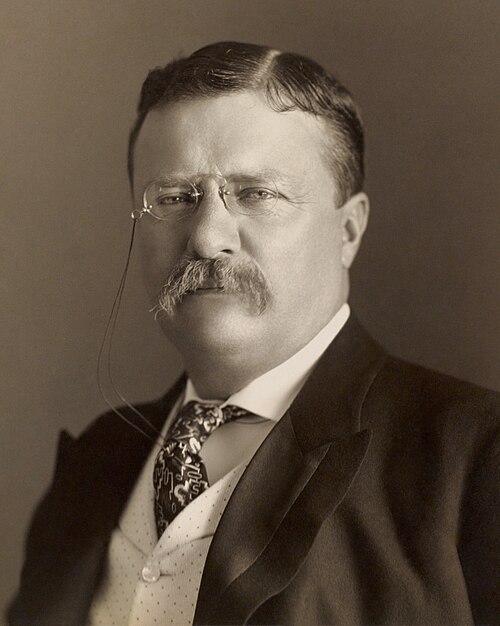
Theodore Roosevelt (October 27, 1858 – January 6, 1919) was the 26th President of the United States (1901–1909), known for advancing progressive reforms, antitrust actions, natural resource conservation, and an assertive foreign policy.
He was born into a wealthy New York family, frail and sickly as a child but overcame his health issues through exercise. He attended Harvard University and Columbia Law School before leaving law for politics. In 1881, he was elected to the New York State Assembly, quickly gaining a reputation as a reformer fighting corruption. In 1884, his wife and his mother died on the same day; he retreated to the Dakota Territory to run a cattle ranch. Remarrying in 1886, he re-entered politics and served as U.S. Civil Service Commissioner, New York City Police Commissioner, and Assistant Secretary of the Navy. During the Spanish–American War of 1898, he organized the "Rough Riders" and rose to the rank of colonel, becoming a war hero. That same year, he was elected Governor of New York, where he pushed reforms, and in 1900, he became Vice President.
Following the assassination of William McKinley in 1901, Roosevelt succeeded to the presidency, becoming the youngest person to hold the office. His administration championed the "Square Deal," combating monopolies (such as breaking up the Northern Securities Company); enacting the Meat Inspection Act and the Pure Food and Drug Act to protect consumers; vigorously promoting conservation by establishing numerous national forests, parks, and reserves; advocating "Big Stick" diplomacy, expanding the Navy, and facilitating the construction of the Panama Canal; and mediating the Russo-Japanese War, for which he won the 1906 Nobel Peace Prize. He was re-elected in 1904 and supported William Howard Taft as his successor in 1908.
After leaving office, he traveled to Africa and Europe for lectures from 1909 to 1910. In 1912, falling out with Taft over policy, he formed the Progressive Party (Bull Moose Party) and ran again for president, losing but achieving the highest vote share for a third party in U.S. history. From 1913 to 1914, he embarked on an expedition to South America, enduring great hardships that left permanent damage to his health. During World War I, he strongly criticized Woodrow Wilson's neutrality policy and called for military preparedness. He died of a pulmonary embolism in 1919 at the age of 60.
Renowned for his boundless energy, strong personality, and the "Rooseveltian" legacy, he is consistently ranked by historians as one of the greatest U.S. presidents.
日主癸水生于戌月,土旺秉令,官星透干乘权,地支午戌合火,财旺生官;日主仅靠月时两壬水劫财扶助,坐下巳火耗身,无根金生,是为身弱官杀重格。 癸水是至阴至柔的雨露之水,原本应是润物无声的存在,但在这个命局里,四面八方都是厚重的土(戌土、戊土)和炽热的火(午火、巳火)。土是癸水的官星,代表规则、使命、压力;火是财星,代表野心、行动力和消耗。这导致罗斯福天生就被置于一个高压锅中,像一个小池塘想推动庞大的山石,外界对他有巨大的期望和约束,他却只能依靠自己的“同类”——那两个壬水劫财来顶住。劫财就像并肩作战的兄弟、战友或者自己内心不服输的劲头。这种能量状态塑造了一个永远在“扛着”的人,给人的整体感觉就像一头披着荆棘的雄狮,表面威严沉稳(官星透干),实则随时准备咆哮着冲破桎梏(劫财不惧官杀)。最大优势是意志力惊人,越是压力越能爆发;潜在挑战则是容易过度消耗自己这根弹簧,当支撑(水)被榨干时,身体或精神可能突然崩溃。
命局以月令戌中戊土正官为格,年时干透戊土正官,格局纯正,但官多成杀,构成‘官杀混杂而身弱’,喜印比帮身为用。用神取金(印星)、水(比劫),忌神为火(财星)、土(官杀)。 可以通俗地这样理解:罗斯福的人生“规定动作”太多——出身名门、从政之路被寄予厚望,法律、道德、公共责任像一道道栅栏(官杀)把他圈住。而金(印星)就像智囊、书本、长辈的教诲,能替他化解压力,化规则为自身智慧,然而他命局中的印星(辛金)深藏在地支戌土里不显露,意味着很难直接获得这类安逸的庇护,他必须自己硬扛。水(比劫)则是他自己的体能、伙伴和顽强意志,是他的救命稻草。所以,他需要像一只海豚不停地游动(比劫做功)才能不被海水咸死。他创立的“莽骑兵”志愿骑兵团、推行的无畏改革,本质上都是“聚水抗土”的体现:集结志同道合的伙伴(劫财),向强大的传统势力(官杀)发起冲锋。忌神火土逼他去追逐野心同时消耗他,忌神火过旺也代表冲动和激进可能烧毁理智,比如他在从政初期过于激进时遭遇的挫败。
最突出的十神组合是‘劫财抗官’,日支藏丙火伤官与庚金正官交混,形成‘伤官见官’但藏而不露的暗流。 劫财抗官,说白了就是“不靠天不靠地,老子靠兄弟和自己”。罗斯福一生多次在困境中凭个人魅力和伙伴打开了局面:在古巴圣胡安山冲锋时的振臂一呼,在总统任上挑战托拉斯时的团队协作,都是劫财在运作。他决策时那种扑面而来的勇气、直觉式的冲动,就是水(日主+劫财)直接撞击堤坝(官杀)的体现,这让他行事果断,甚至有些独断专行。而‘伤官见官’藏在内心,伤官是叛逆、才华和突破欲,正官是秩序和传统。这种内在矛盾使得罗斯福一方面极力维护法律和国家荣誉(官),另一方面又不断挑战旧有规则(伤官),比如他“进步主义”改革,就是用新思维冲击陈腐体制。在人际模式上,他喜欢结交跟他一样能打的勇士(劫财),对立志不同道不合的权贵(官杀)则毫不妥协。这种组合决定了他的事业路径必然是一条冲撞之路:从海军部次长到战场英雄,再到反垄断总统。
年支午火为桃花、将星并临空亡;月时两戌为华盖;日柱带天乙贵人、太极贵人、亡神。命局中午戌半合火局,加大忌神力量;月时两戌伏吟,强化华盖孤独心性。 桃花主魅力、人缘,将星主统御才能,但落空亡,意味着他早期的魅力可能被低估,或内心有失落感,但一旦填实就爆发——他真正成为全美瞩目的英雄是在42岁担任义勇骑兵团长时,那正是大运填实空亡的阶段。华盖是艺术、哲学之星,往往伴随孤高和深邃的精神世界,月时两现华盖,且戌土正官伏吟,他骨子里是孤独的思考者,酷爱阅读和写作(出版数十本书),这是华盖藏印带来的智慧沉淀。天乙贵人给了他多次化险为夷的运气,比如在暗杀中幸存、在战场上刀枪入体仍生还;太极贵人强化了其对事物的敏锐直觉。亡神则是一颗不怕死的煞星,让他敢于冒险,却也招来家庭不幸(第一任妻子和母亲同日去世的悲痛)。午戌合火使得财官忌神气焰更盛,人生挑战加倍,但也正是这些神煞共同铸就了一个魅力超凡、文雅而又暴烈的矛盾统一体。
癸水日主生于秋末,水冷土燥,双壬劫财贴身,官星环伺,心性为‘外柔内刚,智勇双全’。 癸水像清晨的露珠,本应是敏感、细腻、随形就势,但罗斯福的癸水却被火土烤着,想蒸发却被双壬劫财(更旺盛的水)强行拉住,让他不至于干涸,反而激发出一种“露珠也想撼动大山”的倔强。他的思维模式是跳跃而剧烈的:时而像水一样冷静观察(在海军战略上的远见),时而像洪峰一样冲决(在战争和改革中的激情)。情感需求上,他极其渴望同类的理解和支持(劫财代表同伴认同),对背叛零容忍。在压力下,他典型的反应是“燃烧自己,照亮战场”——越被逼到墙角,斗志越旺,这就像癸水被土围困时反而会寻求一切缝隙猛烈穿击。舒适区对他反而是毒药,安逸会使他抑郁,因为水静止就会被土吸干。所以他一生都在寻找挑战,从少年时苦练身体对抗哮喘,到就任总统后仍去非洲探险,都是这种心性的外化。
命局最大优势能量在于劫财的魄力与伤官的才思,官杀虽为忌却锻造成就的标尺。 劫财就是行动力、竞争力和号召力,伤官是智慧、口才和不拘一格。这两者结合,使他拥有一种磁石般的领袖气质——他可以即兴演讲两小时而听众如痴如醉(伤官),也能在危急关头跨上马背高喊“跟我来”(劫财)。这种天赋在需要破旧立新的领域最容易发挥竞争优势。他担任纽约州州长时大刀阔斧整顿不良企业,在总统任上调解日俄战争(因此获诺贝尔和平奖),都是先用“劫财”之勇打开局面,再用“伤官”之智化解国际纠纷。官杀虽是负累,却给了他强烈的荣誉感和对公共事务的使命感,使得他的才华不是空放,而是最终指向了最有价值的赛道——为国家服务。他被称为“美国精神的塑造者”,正是因为他将水(灵活、仁爱)与火土(进取、秩序)的能量平衡成了崭新的国家性格。
核心冲突在于‘财官过旺而身弱,劫财孤军奋战,伤官暗藏制官不够’;这导致他一生在‘过度消耗’与‘力不从心’间拉锯。 财官忌神旺,意味着现实对他总是提出超高标准的要求,他从小就体弱多病(身弱),但硬是用拳击、骑马、打猎等“劫财式”锻炼把自己练成健壮之人,这是典型的“水弱遇土,反激其荡”。然而他始终无法摆脱用力过猛的毛病,从政初期在纽约州议会因过于激进触怒党阀而遭排挤,总统期间进攻托拉斯又与党内老派对立,都是“劫财抗官”的副作用——容易树敌,缺乏迂回。伤官见官的暗流使他时而表现出对上位者规矩的反叛,内心挣扎,例如他因不满继任者塔夫脱的保守而另组进步党,导致共和党分裂,这次“起义”正是伤官抗官的外化,虽然彰显原则,却也损耗了自身及团队的长期利益。性格上的盲点是过于相信个人意志可以压倒一切,忽略了水需要休息,否则一干涸,火土就要反噬——他晚年亚马逊探险染病,身体急剧衰退,即是此象。
综合全盘,西奥多·罗斯福的命运是一部“弱水激荡成飞瀑”的传奇。他的人生核心主题,是用奔腾不息的战斗意志(水)去征服时代赋予的沉重任务(土),并用这股力量重新定义了领袖的定义。他不是温室里的智者,而是旷野中的战士,每一次披荆斩棘,都在给即将到来的美国世纪注入一股原始而纯净的力量。命运让他走了一条先耗尽自己,再照亮他人的道路:少年时用汗水击败病魔,中年时用勇气击败敌人,盛年时用理想击败旧时代,最终也因这份燃烧而早早燃尽了自己。他逝世时不过六十岁,但留下的遗产却如长江大河,灌溉了整个民族。从命理角度看,这恰是忌神火土虽旺终未能困住一点癸水真魂,反使其迸发出大江奔海之姿——虽有苦涩,却成不朽。
比劫帮身,食神受制。 这十年是生命力的奠基期,由兄弟朋友的能量主导,意味着身体和性格的初步塑造。命主通过自强和伙伴支持克服先天不足,处于快速成长阶段,但易有病痛和竞争。
比劫夺财,印星衰弱。 事业上尚无实质建树,资源来自家庭和他人的帮扶。命主需要依赖父辈的余荫和同伴的协作,但自身力量增强,为日后积累基础。收入结构简单,开销多用于学习和身体锻炼。
劫财透干,人际活跃。 朋友圈广泛,但关系以互助和竞争并存。家庭中多兄弟姊妹互动,父亲影响较大。年少时已展现出领导力,但易因好胜引发矛盾。
水旺土弱,注意呼吸系统。 天干癸水加重湿气,地支亥水冲巳火,易有哮喘或肺部敏感。需加强有氧锻炼,增强心肺功能。情绪上要防止自卑或急躁。
伤官配印,智识开显。 这十年以伤官(才华释放)和正印(学习吸收)交替主导,是知识积累和个性张扬的阶段。命主进入青年,开始展示超群的思维和表达能力,同时接受高等教育,为从政铺路。
伤官生财,印星护身。 事业上偏向学术和政论,写作和演讲能力突出。考入哈佛大学,奠定人脉基础。资源方面有家族支持,但伤官也带来叛逆,与权威时有冲突。财运平稳,花钱大方,多用于社交和知识投资。
正印透干,贵人运强。 师长和长辈欣赏其才华,提携颇多。与同学关系融洽,但伤官心性易与人争辩,交友需注意分寸。感情上开始萌发,但尚不稳定。名声在校内渐显。
甲木克土,胃肠易弱。 学业压力大,饮食不规律。注意消化系统保养。运动可缓解精神紧张,建议定期进行户外活动。
食神制杀,事业起步。 食神(才华转化)压制七杀(压力挑战),这十年是职业技能成型和初涉官场的阶段。命主经历婚姻、生子、从政初期,在纽约州议会崭露头角,同时承受丧妻之痛等打击,意志力得到锤炼。
食神生财,七杀攻身。 事业上通过写作和演讲获得声望,当选州议员,但七杀带来政敌攻击和意外挫败。资源方面,妻子去世导致家庭破费,但个人努力挽回局面。收入来自薪水和稿费,经济压力较大。
七杀为忌,情感波折。 1884年妻子和母亲同日去世,巨大悲痛。之后重组家庭,与第二任妻子育有子女。社交圈扩展,与政治人物结盟,但树敌也不少。名声因勇敢面对逆境而提升。
乙木克土,七杀攻身。 精神压力大,易有失眠或神经衰弱。需注意调节心态,通过阅读和写作释放压力。体质尚可,但要防止积劳成疾。
财星架印,官杀得地。 正财(稳定收益)和伤官(行动力)配合,这十年是事业飙升期。命主担任美国文官委员会成员、纽约市警察局长、海军助理部长,并因美西战争成为英雄,知名度大增,为州长和副总统之路铺垫。
财官相生,权位攀升。 事业上政绩突出,通过改革和强硬手段提升声望。1898年带领“莽骑兵”冲锋,奠定英雄形象。资源方面,获得总统麦金莱赏识,财富主要来自薪水和投资,但支出巨大用于政治活动。
伤官生财,人脉开拓。 结识大量军界、政界精英,与记者、富豪关系密切。家庭稳定,妻子支持事业。名声如日中天,但伤官也导致部分保守派反感。
火旺耗水,注意心脏和视力。 工作过于投入,需防过度劳累。建议规律作息,适当运动。情绪上易急躁,应培养耐心。
食神生财,杀印相生。 偏财(意外收获)与食神(才华发挥)主导,这十年是权力顶峰。1901年因总统遇刺而继任,1904年连任,推行进步主义改革,修建巴拿马运河,获诺贝尔和平奖。食神制杀,化解国内外危机,成就卓著。
偏财透干,权倾朝野。 事业上施展抱负,打破垄断,保护自然资源。资源方面,积累了巨大政治资本和财富,但因改革得罪财阀。收入来自总统薪俸和著作版税,投资亦获得回报。
食神吐秀,人气高涨。 得民心,支持率很高。与女儿爱丽丝关系紧张,但与妻子融洽。与国会部分议员冲突,但凭借个人魅力维系政治联盟。名声享誉国际。
卯木克土,脾胃负担重。 饮食不规律,常因工作忽略健康。注意胃溃疡和消化不良。精力旺盛但需劳逸结合,防止过度操劳。
官星重重,财印相战。 正官(压力与规则)双现,这十年是转折期。卸任后前往非洲探险,1912年组建进步党再度竞选失败,官星带来新的束缚和挑战。命主试图重返权力中心,但遭遇滑铁卢,进入人生后半场的调整阶段。
官杀混杂,竞争激烈。 事业上有大动作,但受到旧党掣肘。非洲之行虽成功,但政治复出失败。资源方面,演讲和写作收入可观,但竞选耗费巨大。财富略有缩水。
官星为忌,人脉分化。 与共和党分裂,与儿子们关系密切。1914年亚马逊探险,儿子重病。社交圈缩小,但忠实追随者仍多。名声因冒险活动得以维持。
土旺克水,肾脏系统堪忧。 年龄增长,需注意泌尿和关节问题。1919年因心脏病去世,此运末期健康急转直下。应减少劳累,定期检查。
The Parents Palace has Tai Yang (Sun) in Bu (Detriment), Tai Yin (Moon) in Miao with Hua Quan (transforming into Authority), plus Tian Kui (Heavenly Leader), Di Kong (Earth Void), and Ling Xing (Thorn Star) all present. Tai Yang Bu means the Sun is in detriment, indicating the father's radiance dimmed and his influence weakened; Tai Yin Miao Hua Quan means the mother's authority prominent, controlling family power. Tian Kui is a helping star, symbolizing parental social connections and assistance; Di Kong represents spiritual emptiness or hidden family secrets; Ling Xing is a star of sudden alarm. Tai Yang in detriment implies early death or prolonged absence of the father, whose teachings were profound but brief; Tai Yin Hua Quan manifests as the mother's strong-willed nature, being a Southern belle who sustained the family after the Civil War and directed the children's education. Tian Kui and Di Kong together: the parents' social circle provided Roosevelt with important connections (his father's ties to finance and politics), but Di Kong hints at deliberately downplayed or lost family episodes—such as divided loyalties during the Civil War. Ling Xing's arrival foretells a drastic sudden event: in 1884, his mother died of typhoid on the same day as his wife, becoming the greatest trauma of his life. Under this stellar combination, the parents are portrayed as a 'briefly brilliant father' and a 'long-dominant mother,' the former instilling duty, the latter molding resilience; yet Di Kong and Ling Xing also embed rupture and agony in the nurturing bond.
Tai Yin Hua Quan in the Parents Palace directly grants the mother power and influences the native's career choices. Tai Yin is a soft star, but transforming into Hua Quan becomes a firm, practical controller—Mittie Bulloch, after her husband's early death, not only managed finances but also intervened in Roosevelt's marital decision (supporting his marriage to Alice Lee). No other transformations in this palace, but we can observe the opposite Children Palace's Di Jie (Earth Robbery) star: Di Jie signifies challenges in children relationships, reflecting parental anxiety over family continuity; Roosevelt fathered six children with two wives, but eldest daughter Alice Lee (from first marriage) was raised by an aunt after her mother's death, restructuring the family after the double loss in the Parents Palace. The trios: the Career Palace (Zi Wei, Tian Xiang, Tuo Luo) brings leadership with obstacles, and the Wealth Palace (Lian Zhen, Tian Ma) shows busy financial management for career, but these are not directly from Parents Palace transformations; rather, Tai Yin Hua Quan spurred action—Roosevelt plunged into politics after his father's death, and sought solace in wilderness and writing after his mother's.
In 1878, when Roosevelt was 20, his father Theodore Sr. died of intestinal cancer (Tai Yang Bu fulfilled), leaving him devastated, writing in his diary, 'My whole world has collapsed.' His father was a businessman and philanthropist who taught Roosevelt 'duty first,' a creed he later lived by. His mother Mittie Bulloch (Tai Yin Hua Quan) was a strong-willed Southern aristocrat who managed the family after her husband's death and supported Roosevelt's admission to Harvard. However, during the Civil War, Mittie was a Southern sympathizer while the Roosevelt family supported the North, creating political division (clash of Tai Yin Hua Quan and Tai Yang Bu values). On February 13, 1884, his mother Mittie died of typhoid, and on the same day his wife Alice Lee died from postpartum complications (the peak of Ling Xing's sudden event), Roosevelt drew a large cross in his diary and wrote, 'The light has gone out of my life.' He then abandoned politics, went to the Dakota Territory to run a ranch (driven by the connections and emptiness of Tian Kui and Di Kong). Tian Kui brought helpers like his father's friends and New York high society, paving the way for his later political career; Di Kong reflected the contradiction in his background—Dutch aristocratic blood vs. common-man politician.
In the Spirit Palace (Fortune Palace), Tan Lang (flat) transformed into Wealth (Hua Lu), You Bi transformed into Reputation (Hua Ke), and Wen Qu (flat) co-located. Tan Lang is a Peach Blossom star, governing talents, social skills, and desires; Hua Lu enhances enjoyment and material acquisitions. You Bi Hua Ke adds helpful people and reputation; Wen Qu governs academic talent and romance. This combination indicates a rich spiritual life, optimism, and a focus on pleasures and artistic taste. Roosevelt was a renowned naturalist and accomplished writer who enjoyed hunting, reading, and keeping journals (the hobbies of Tan Lang Hua Lu). You Bi Hua Ke brought assistance from others (e.g., hunting guides, secretaries). Wen Qu granted him fluency in writing and best-selling books.
Tan Lang Hua Lu brings blessings to the Spirit Palace, yielding both material and spiritual harvests; You Bi Hua Ke earns good reputation and esteem from others. Hua Lu turns his hobbies into practical benefits (best-selling books); Hua Ke makes him recognized as the 'Father of Conservation' (Roosevelt National Parks, etc.).
Roosevelt loved outdoor activities throughout his life, collected numerous animal specimens, and wrote books like 'African Game Trails' and 'Through the Brazilian Wilderness'. These hobbies spread his fame far and wide. His optimistic personality (Tan Lang's social skills) affected others, and he hosted many social events at the White House. Wen Qu brought him literary acclaim; in 1906 he won the Nobel Peace Prize (You Bi Hua Ke aided international prestige). In his later years, he published articles in academic journals, keeping his spiritual life fulfilled.
The Destiny Palace has Wu Qu (Military Tune) and Tian Fu (Heavenly Treasury) co-present, with Zuo Fu (Left Assistant) and Wen Chang (Literary Star) converging, forming the 'Warrior Star Gains Assistance' pattern. Wu Qu is a wealth and Wealth Star, representing fortitude, decisiveness, and pragmatic financial management; Tian Fu is a treasury star, indicating stability, inclusiveness, and overall planning. Zuo Fu is a helping star, Wen Chang a literary star, symbolizing helpful people and scholarly cultivation. This combination means the native combines a general's boldness with a minister's strategy, able to assemble a think tank and act with both resolution and long-term planning. In Roosevelt, this manifested as being leader of the 'Rough Riders' (Wu Qu) and formulating national policies like the 'Square Deal' (Tian Fu), with constant support from legal advisors and military generals (Zuo Fu Wen Chang).
This Palace has no Four Transformations directly. (Note: The opposite Travel Palace's Qi Sha is not transformed according to the chart; the Body Palace's Lian Zhen also has no Hua Lu. The only transformations in the chart are Tian Ji Hua Ji in Property, Tan Lang Hua Lu in Fu De, and Tai Yin Hua Quan in Parents.) Thus this section focuses on star combinations, no need to force Four Transformations.
The Destiny Palace's Wu Qu and Tian Fu at Zi correspond to Roosevelt's background: born into a wealthy New York family but frail as a child (Wu Qu's Metal element overcomes Wood, weak liver and gallbladder, prone to asthma). He overcame his weakness through perseverance (Wu Qu's toughness). Adulthood saw him as New York Assemblyman, Assistant Secretary of the Navy, and Governor of New York, each step displaying Tian Fu's planning and Wu Qu's executive power. Forming the 'Rough Riders' for the Spanish-American War exemplified Wu Qu's martial spirit. In later years, organizing the Progressive Party was a Tian Fu-style effort to rally resources. Zuo Fu and Wen Chang showed in his extensive network of scholars, journalists, and politicians, such as his interactions with John Muir.
The Siblings Palace has Tian Tong (Heavenly Unity) in Miao (Temple/Waxing) residing, with Huo Xing (Fire Star) in Li (Favorable) co-present. Tian Tong is a star of blessings, symbolizing harmony, enjoyment, and coordination. When in Miao it becomes particularly warm-hearted and tolerant; Huo Xing represents impatience and outburst, and in Li its destructive power is somewhat reduced but still indicates sudden conflicts. The combination produces a chemical reaction: Tian Tong's gentleness does not fully suppress Huo Xing's fiery nature, instead creating a surface harmony with undercurrents of tension—the sibling relationship is deeply affectionate yet prone to intense conflicts due to personality differences or external stimuli. For Roosevelt, this stellar quality manifested concretely: his sister Anna (Tian Tong Miao) was his lifelong emotional pillar, gentle and caring, helping care for his children after his wife's death; while his brother Elliott (Huo Xing Li) was impulsive and dissolute, who, after military service, developed alcoholism and died prematurely in 1898, causing Roosevelt great grief. Huo Xing's 'outburst' quality also appeared in political clashes—Elliott publicly criticized Roosevelt's policies, causing temporary strain. Tian Tong Miao ensured overall sibling love, but Huo Xing remained like a thorn, reminding Roosevelt of the deep but regretful bond.
This Palace has no direct Four Transformations, and the opposite Palace (Health & Illness) and the supportive trios (Destiny Palace Wu Qu Tian Fu, Spouse Palace Po Jun) also lack Four Transformation influences. However, the Fu De Palace (Virtue & Fortune) has Tan Lang Hua Lu (Desire Star transforming into Output) (with You Bi Hua Ke, Assistance Star transforming into Moderation) affecting the Siblings Palace through a hidden connection: Tan Lang Hua Lu indicates expansion of desires and relationships, You Bi Hua Ke adds support, implying that Roosevelt's sibling relationships indirectly benefited from his social network—Anna once helped expand his political connections through her diplomat husband. Also, the Tian Zhai Palace (Property) has Tian Ji Hua Ji (Engine Star transforming into Obstacle) (with Ju Men) forming a Six Harmony relation with the Siblings Palace (Mao and Hai), Tian Ji Hua Ji signifying worries and communication barriers, hinting at subtle conflicts over family matters like inheritance or maternal favoritism. Roosevelt's later memoirs mention Elliott's resentment over greater financial support from their mother, matching Tian Ji Hua Ji's 'undercurrent' trait. Overall, although the Four Transformations are not in this Palace, the flying stars and palace interplay reinforce the keynote of 'blessings and misfortunes coexisting, warmth with thorns'.
Roosevelt's relationship with his sister Anna Roosevelt (Bamie) was his most stable familial bond. Anna was born in 1855, three years older, and Tian Tong's 'blessings' reflected in her consistent rational and warm support: after Roosevelt's first wife Alice died in 1884, Anna took charge of caring for his daughter and encouraged his political career; during his terms as New York governor and president, she often acted as his informal adviser, even helping mediate conflicts with opponents—mirroring Tian Tong's coordinating trait. His brother Elliott Roosevelt, born in 1860, displayed Huo Xing Li's 'impetuousness': he was expelled from Harvard for drunkenness, joined the army and fought bravely, but postwar alcoholism worsened, leading to his death from cirrhosis on August 14, 1898 at age 38. Roosevelt wrote in his diary: 'Elliott was the most talented and self-destructive man I ever knew.' Huo Xing's 'suddenness' also surfaced in a physical altercation: according to family records, they once came to blows over political differences, not speaking for months. These events confirm the Siblings Palace of Tian Tong Miao and Huo Xing Li interwoven with warmth and scars, and Roosevelt learned the profound lesson of 'loving someone but unable to change them'.
Po Jun (Broken Army) in prosperous state sits in the Spouse Palace, with no auxiliary stars; the opposite Migration Palace has Qi Sha (Indirect Officer) in prosperous state plus Qing Yang (Angular Star) in fallen state forming a vicious pattern. Po Jun is a star of depletion, governing destruction, pioneering, and drastic change; in its prosperous state, its power erupts, making marriage prone to overturning events. Qi Sha is a general star, and Qing Yang is punishment and injury; both clash with the Spouse Palace, intensifying conflict and separation tendencies. For the native, this combination implies that spouse selection leans toward independent, bold, and adventurous women, but the marriage trajectory is destined to be turbulent—likely experiencing bereavement, remarriage, or long periods of separation and reunion. Po Jun's pioneering nature also manifests as the spouse becoming a revolutionary partner in the native's career, but its destructive force catalyzes major emotional turning points.
This palace has no Four Transformations, but it is pulled by flying stars from the opposite palace and Trio Palaces. The Fortune Palace's Tan Lang (Desire Star) transforming into Lu (Accumulation) and You Bi (Right Assistant) transforming into Ke (Fame) provide a "borrow-star settle-palace" effect, causing the native to gain mentor-type benefactors in the spiritual realm, indirectly enhancing the spouse's talents or social charm—for example, Roosevelt's second wife Edith was sociable and supported his political career. The Career Palace's Zi Wei (Emperor Star) transforming into Ke (the natal Bing stem makes Zi Wei transform into Ke) mirrors the Spouse Palace, with the spouse playing an honorable role in the native's career, as Edith conducted herself properly in social functions at the White House. However, the Property Palace's Ju Men (Gigantic Gate) transforming into Lu (the natal Ren stem makes Ju Men transform into Lu) and the Servants Palace's Tian Liang (Celestial Beam) transforming into Quan (Authority) suggest that the family gains property benefits through marriage, but the spouse's excessive authority among friends could cause hidden strife.
In 1884, Roosevelt's first wife, Alice Lee Roosevelt, died four days after giving birth to their daughter, and on the same day his mother also passed away; this double blow confirms Po Jun's 'breaking' and the death-bringing afflictions of Qi Sha and Qing Yang. This event prompted him to temporarily leave politics and retreat to his ranch. In 1886, he remarried Edith Carow, who with her steadiness and tolerance supported his career, but Po Jun's turbulence persisted: after marriage, Roosevelt frequently went on long expeditions and hunts (e.g., the Amazon River journey in 1914), leading to prolonged separations; Edith strongly opposed his risky endeavors, and conflicts brought out the clashes of Qi Sha and Qing Yang. The marriage overall was long-lasting, but emotions ebbed and flowed like the tides of Po Jun.
The Children Palace has Di Jie (Earthly Catastrophe) sitting alone, with no main star, and borrows from the opposite palace Tian Ji (Celestial Mechanism) transforming into Ji (Obstruction) and Ju Men (Gigantic Gate) in temple. Di Jie's nature is emptiness, separation, destruction; combined with Tian Ji transforming into Ji's turmoil and instability, and further encountering Ju Men's disputes and concealment, it forms a pattern of weak affinity with children and many misfortunes. Di Jie governs upheaval and sudden loss; Tian Ji transforming into Ji represents plans going awry and constant change; Ju Men implies communication barriers and hidden pain. The chemistry of this combination is: the native's relationship with children is inherently fragile and prone to break due to external events or internal estrangement. Behaviorally, although Roosevelt deeply loved his children, he often intervened in the family as a stern reformer, trying to mold his children's masculine character (the opposite palace's Tian Ji transforming into Ji bringing overthinking and Ju Men's stubbornness), which instead led to estrangement or rebellion—for example, he forced his eldest son to practice boxing and long-distance hiking, which bred a hidden resistance against the father.
This palace has no Four Transformations, but its stem Xin triggers the opposite palace's Tian Ji transforming into Ji, creating a strong pull between the Children Palace and the Property Palace. The opposite palace's Tian Ji transforming into Ji is activated by the Children Palace's stem (Xin), meaning that the circumstances of the children directly affect the family's foundation (Property Palace, ancestral property, domestic affairs). The volatility and miscalculations of Tian Ji transforming into Ji erupt through events concerning children: the eldest son Theodore III died in battle during World War I (1918), precisely an expression of Tian Ji transforming into Ji—the shattering of plans and loss of life. Meanwhile, Ju Men (though not technically transforming into Ji in the Property Palace, but its inherently concealing nature) caused endless quarrels within the family over child education, such as Alice's rebellious behavior leading to multiple public scoldings by Roosevelt, causing family disgrace. Additionally, the Destiny Palace's stem Jia makes Lian Zhen (Integrity Star) transform into Lu (Accumulation) into the Wealth Palace, bypassing this palace; but the Fortune Palace's Tan Lang (Desire Star) transforming into Lu and You Bi (Right Assistant) transforming into Ke, in the Trio position to the Children Palace, suggests that although the children bring many difficulties, they indirectly provide spiritual reflection or artistic drive in the mental realm (Fortune Palace)—after his children died, Roosevelt wrote books such as The Winning of the West, partially healing his grief over the loss of his sons.
The Children Palace's Di Jie directly manifested in the death of the eldest son and the rebellion of the daughter. Theodore Roosevelt III (Ted III) died on the French battlefield in July 1918, just five months before his father's death; Roosevelt's spirit never recovered, hastening his own death in 1919—Di Jie's emptiness and separation struck precisely. His daughter Alice Roosevelt was rebellious from youth, smoking, gambling, and associating with politicians; Roosevelt called her 'lawless,' and she openly defied him at home, perfectly embodying Di Jie's 'deviant from norms' quality. His second son Kermit committed suicide during World War II (1943), after Roosevelt's death, but Di Jie's 'depletion' pervades the family. Third son Archie was seriously wounded in World War II, and fourth son Quentin died in aerial combat in World War I (July 1918, actually the youngest). With Di Jie and the borrowed Tian Ji transforming into Ji, the only relatively calm child was daughter Ethel, but under Di Jie's influence, overall the children's achievements were overshadowed by death or conflict.
In the Property Palace (Tian Zhai), Tian Ji (flourishing) transformed into Difficulty (Hua Ji), with Ju Men (temple) co-located. Tian Ji is the intelligence/change star; Ju Men is the darkness star, governing disputes and conflicts. When Tian Ji transforms into Hua Ji, any movement may incur trouble; in the Property Palace, this suggests instability or disputes related to homes or real estate. Ju Men in temple state is eloquent, but may cause family discord due to speech. Roosevelt owned a New York mansion and Sagamore Hill estate, but he had disagreements with family over its expansion designs (Ju Men's disputes), and due to frequent travels, he was often away from home (the restlessness of Tian Ji Hua Ji).
Tian Ji Hua Ji denotes a triggering of misfortune, signifying changes or losses in the home environment. Hua Ji makes Tian Ji's flexibility become obstruction, manifesting as disputes over property division or house repairs. In his later years, Roosevelt was not financially abundant and sold some properties to fund his expeditions.
Roosevelt's Sagamore Hill estate was his primary residence, but he was often away (Tian Ji Hua Ji leaving home). After his death in 1919, the estate was inherited by his children but later sold (the loss of Hua Ji). He wrote in his study, but the Ju Men influence: he often argued with his children over political views. Additionally, his New York residence as a youth was demolished due to urban redevelopment (the changes of Tian Ji Hua Ji).
In the Career Palace (Guan Lu), Zi Wei (auspicious) and Tian Xiang (auspicious) are together, with Tuo Luo (temple) co-located. Zi Wei is the Emperor star, symbolizing supreme leadership and authority; Tian Xiang is the Minister star, representing systems, assistance, and coordination; Tuo Luo is a hidden star, indicating delay, obstruction, and repetition, but in temple state it shows resilience. The Zi Wei-Tian Xiang combination suggests the native's career must follow a management, judicial, or political path, and can reach the highest position, but Tuo Luo's involvement makes the process far from smooth. Roosevelt's political career exemplifies this: he first entered the New York State Assembly as a reformer, but his sharpness led to a crushing defeat in the 1886 New York mayoral election (Tuo Luo's first setback); he unexpectedly succeeded to the presidency in 1901 after President McKinley's assassination (Zi Wei's sudden rise); then he aggressively pursued antitrust and conservation policies, only to face constant delays from congressional conservatives (Tuo Luo's recurring entanglements); in 1912, he formed the Progressive Party and ran for president, ultimately losing to Wilson (Tuo Luo's reappearance). Yet after each defeat, he rebounded quickly, eventually becoming one of the youngest and most influential presidents in U.S. history—the 'tempered into gold' effect of the Zi Wei-Tian Xiang pattern.
This palace has no direct Four Transformations, but indirect influences come from the opposite palace (Spouse Palace's Po Jun flourishing), the Wealth Palace (Lian Zhen temple, Tian Ma), the Travel Palace (Qi Sha flourishing, Qing Yang declining), and the Spirit Palace's Tan Lang Hua Lu and You Bi Hua Ke, all exerting pressure on the Career Palace. Po Jun in the Spouse Palace suggests that the drive to 'break old and establish new' in career often comes from marriage or partners—after the death of his first wife Alice, Roosevelt recuperated in the western ranches, ironically accumulating political capital; his second wife Edith's support provided a stable foundation for his reelection. The Travel Palace's Qi Sha and Qing Yang indicate fierce competition during external pursuits—he formed the 'Rough Riders' in the Spanish-American War, shaping his rugged image but also making many enemies due to his aggressive style. The Wealth Palace's Lian Zhen and Tian Ma suggest that wealth comes from travel and reform—his push for railroad and food regulations, though angering tycoons, won public support. Crucially, the Spirit Palace's Tan Lang Hua Lu and You Bi Hua Ke illuminate the Career Palace: his political vision (Tan Lang's pioneering nature and Hua Lu's blessings) often earned him mentors and supporters (You Bi Hua Ke), such as his appointment as Assistant Secretary of the Navy under President McKinley, and the 1900 vice-presidential nomination, both thanks to the appreciation of senior political figures. Although the Property Palace's Tian Ji Hua Ji does not directly relate to career, it hints at entanglements arising from family inheritance (property): he inherited a large fortune in his youth, but was mocked by opponents as an 'aristocratic reformer', ironically spurring him to align even more with the common people.
1886 defeat in NYC mayoral race (Tuo Luo's first appearance) → 1898 elected Governor of New York (Zi Wei emerges) → 1901 succeeded to the presidency (Zi Wei ascends) → 1904 reelection (Tian Xiang's institutional protection) → 1912 Progressive Party loss (Tuo Luo reappears). Specifically: In 1886, at just 28, Roosevelt ran as a Republican for New York City Mayor, but suffered a crushing defeat due to party splits and inexperience, which taught him the necessity of political compromise. In September 1901, President McKinley was assassinated, and Roosevelt, as Vice President, automatically succeeded at age 42, becoming the youngest president in U.S. history—a dramatic example of Zi Wei-Tian Xiang's 'unintended rise.' During his tenure (1901–1909), he enforced the Sherman Antitrust Act against Standard Oil, signed the Newlands Reclamation Act for natural resource conservation, and mediated the Russo-Japanese War earning the Nobel Peace Prize—each step highlighting Tian Xiang's inclination towards institution-building. However, after deciding not to run in 1908 and supporting Taft, he became disillusioned when Taft abandoned his reform agenda, leading him to form the Progressive Party (Bull Moose Party) and run as a third-party candidate in 1912, ultimately losing to Democrat Wilson. This defeat, though seemingly a Tuo Luo delay, actually laid the foundation for the legacy of 'Progressivism'.
The Servants Palace (Nu Pu Gong) contains Tian Liang (Celestial Beam) in a fallen state and Lu Cun (Salary Star) together, forming a 'Sheltering Star Protecting the Treasury' pattern. However, the fallen state limits the extent of protection. Tian Liang is the third star of the Southern Dipper, belonging to the Earth element. It governs pure nobility, longevity, and sheltering protection, carrying the connotations of 'upright official' and 'elder'. In the Servants Palace, it indicates that the native's subordinates and friends are mostly experienced and uphold moral principles. However, the fallen position weakens this sheltering effect, easily leading to situations where support is offered but limited, or surface-level backing masks reservations. Lu Cun is the third star of the Northern Dipper, also Earth element, governing wealth, salary, and the treasury of personal connections, strengthening the ability to gather resources within social networks. The combination shows that in Roosevelt's team, there were loyal and courageous followers like the 'Rough Riders', as well as financial supporters attracted by Lu Cun (such as donations from tycoons). However, the fallen Tian Liang also suggests that some relationships later developed ideological differences or conflicts of interest—for example, his friendship with Taft ultimately broke due to political disagreements; the 'mature' demeanor of fallen Tian Liang could easily turn into stubbornness under pressure, leading to cracks in interpersonal relationships. Although Zuo Fu (Left Assistant) and Wen Chang (Literature Star) are in the Destiny Palace, the Servants Palace lacks auxiliary stars to strengthen it, so the breadth of connections outweighs depth, and many relationships gather due to events and disperse due to ideals.
The palace has no major star undergoing transformation, but Stem Ding triggers 'Tai Yin transforming into Hua Lu' entering the Parents Palace, 'Tian Tong transforming into Hua Quan' entering the Siblings Palace, 'Tian Ji transforming into Hua Ke' entering the Property Palace, and 'Ju Men transforming into Hua Ji' entering the Property Palace, forming the four transformations of Lu, Quan, Ke, Ji that project into the Triple Union and Opposite Palaces, indirectly regulating the interpersonal energy of the Servants Palace. Among the Stem Ding transformations, Tai Yin (Moon) transforming into Hua Lu (Resolution) in the Parents Palace (with Tian Kui, Di Kong, Ling Xing) channels resources from elders and authority figures into the network of connections—Roosevelt's presidential career was deeply influenced by his father Theodore Roosevelt Sr. and his uncle, providing shelter for his political beginnings. Tian Tong (Heavenly Child) transforming into Hua Quan (Authority) in the Siblings Palace (with Huo Xing) endows brothers and allies with mobilization capability; the rapid assembly of Harvard alumni and western cowboys in the 'Rough Riders' reflects this Tian Tong Quan image. Tian Ji (Heavenly Secret) transforming into Hua Ke (Reputation) and Ju Men (Giant Gate) transforming into Hua Ji (Annoyance) both enter the Property Palace (Tian Ji in Exalted state but transformed into Ji, Ju Men in Temple); the interweaving of Ke and Ji leads to entanglement between family and social circles: Tian Ji Ke grants him the ability to win public support through media and speeches (Ju Men represents speech), yet Hua Ji harbors hidden domestic unrest or the risk of friends turning against each other over words—for example, his cooperation with newspaper magnate Hurst later turned into opposition. The opposite Travel Palace with Qi Sha (Indirect Officer) and Qing Yang (Obstacle) directly clashes with the Servants Palace; Qi Sha's aggressiveness and Qing Yang's rupturing nature cause Roosevelt to often engage in fierce competition and break old establishments to form alliances in interpersonal arenas, but also easily attract hidden injuries.
The formation of the 'Rough Riders' volunteer cavalry regiment in 1898 epitomizes the fallen Tian Liang with Lu Cun: Tian Liang's 'sheltering' transformed into rallying seasoned followers like cowboys, sheriffs, and Indian hunters, while Lu Cun attracted financial support from magnates such as railroad king James J. Hill to sponsor military supplies. After assuming the presidency in 1901, he recruited many journalists and scholars into the government (like the 'Kitchen Cabinet'); the 'advisor' quality of fallen Tian Liang allowed these people to advise without full dependency, but in 1904, his estrangement from aide William Loeb Jr. due to press conflicts marked the boundary of the fallen palace's support. The most obvious friend-turned-foe occurred in 1912: a complete break with former President William Howard Taft; the 'transformation of grace and righteousness' from fallen Tian Liang led Taft to accuse Roosevelt of 'bad faith' at the Republican National Convention, after which Roosevelt formed the Progressive Party—the political and financial resources accumulated by Lu Cun (such as funding from publisher Frank Munsey) sustained his independent campaign, but fallen Tian Liang also caused him to lose support from old-guard Republicans. Additionally, he repeatedly maintained private friendships as 'President' with journalists like John Bass Bishop, using the media to advance antitrust policies, which reflects the fallen Tian Liang's 'weak but still existing' transmission chain.
Qi Sha (Indirect Officer) in Exalted state and Qing Yang (Obstacle) in Fallen state in the same palace, forming the pattern of 'Warrior General Leaving the Frontier'. Qi Sha is a General Star, governing initiation, adventure, and reform; in Exalted state, will is steadfast and action decisive. Qing Yang represents punishment and injury, governing conflict, accidents, and competition; in Fallen state, sharpness is fully revealed but easily attracts disputes. The chemical reaction of this combination: Qi Sha's pioneering force is ignited by Qing Yang's intensity, forming a behavioral cycle of 'collision-breakthrough-collision again'—the native outside will actively seek high-risk, high-conflict scenarios and realize personal value through intense clashes. Roosevelt's life-long passion for expeditions and political wrangling embodies this momentum: in his youth, he went to a western ranch to tame cattle and brawl; in middle age, he launched the Spanish-American War and promoted the Panama Canal; in his later years, he ventured deep into the Amazon rainforest—each episode brimming with physical or political frontal confrontations. Qing Yang's limitation lies in excessive conflict that triggers backlash; for instance, his break with Taft after leaving office in 1908 and his formation of the Progressive Party in 1912 causing the Republican split both illustrate 'injuring the enemy one thousand while losing eight hundred' in the process of outward expansion.
The palace has no four transformations, but Tan Lang (Desire Star) transforming into Hua Lu in the Fortune Palace and Tian Ji transforming into Hua Ji in the Property Palace strongly influence the Travel Palace through flying stars. Tan Lang transforming into Hua Lu in the Fortune Palace illuminates the Travel Palace from the opposite palace: Tan Lang governs sociability, talent, and desire; Hua Lu endows the native with exceptional social charm and resource integration ability abroad—Roosevelt's ability to secure funding from various countries during his African safari and win over local guides during his South American expedition relied on this Hua Lu's lubrication. Tian Ji transforming into Hua Ji in the Property Palace illuminates from the Triple Union: Tian Ji governs planning and change; Hua Ji brings chaos to the family or logistical sphere (such as selling his eastern property after his wife's death in 1884 and venturing west alone), and this 'internal worry' instead pushed him to seek new horizons outside. In short, although the Travel Palace lacks transformations, external connections are abundant due to Hua Lu in the Fortune Palace, and retreat is unstable due to Hua Ji in the Property Palace, creating a fatalistic drive of 'having to venture out and bound to succeed once venturing'.
The Travel energy of Qi Sha and Qing Yang pervades Roosevelt's key life turning points. In 1884, his wife and mother died on the same day; he abandoned his political career and went to the Dakota ranch, becoming a cowboy hunting bison and confronting outlaws—a classic outburst of Qi Sha and Qing Yang in the Travel Palace: using extreme environments to heal inner trauma. In 1909, the month after leaving the presidency, he set off for an African safari, lasting a year and collecting thousands of specimens; along the way, he clashed with indigenous tribes and contracted malaria (Qing Yang's injury), yet donated trophies to the Smithsonian Institution (Qi Sha's achievement). The 1913-1914 Amazon expedition was the most perilous: he led a team exploring the 'River of Doubt', capsized in rapids, contracted severe fever causing a weight loss of 57 pounds, and even asked the accompanying doctor for poison to seek release (Qing Yang in Fallen state's extreme despair), but ultimately completed charting the river and named it after himself (Qi Sha in Exalted state's conquest). Politically, the Travel Palace energy drove him to promote the Panama Canal, using 'Big Stick' policy to display force in the Caribbean; in 1912, forming the Progressive Party stirred a national campaign whirlwind, glorious in defeat, fully demonstrating Qi Sha's nature of 'expanding frontiers abroad, growing bolder in battle'.
Lian Zhen (Integrity Star) in its temple (prosperous) position sits in the Palace of Wealth, with the Body Palace also here, and Tian Ma (Heavenly Horse) in the same degree, forming the "Lian Zhen Tian Ma" combination. Lian Zhen's qi transforms into "imprisonment," belongs to Yin Fire, and in the Palace of Wealth governs earned income and fixed income, accumulating wealth through public office, profession, or reputation, disliking speculative windfalls. Tian Ma governs movement, migration, and distant sources of wealth; the combination implies that wealth needs to be obtained through mobile affairs such as travel, exploration, writing, or public speaking. The Body Palace falling in the Wealth Palace further emphasizes that the life focus is on wealth management—although Roosevelt was born into nobility, as an adult he was financially independent, mainly relying on the presidential salary, book royalties, and speaking fees. Lian Zhen's "imprisoning nature" manifests as cautious financial management without profligacy; Tian Ma pushes him to continually transform experiences into commercial works: after the African scientific expedition of 1909–1910, he published African Game Trails; after the South American expedition of 1913–1914, he published Through the Brazilian Wilderness, both yielding huge royalties. At the same time, Qi Sha (Indirect Officer) and Qing Yang (Angular Star) in the Migration Palace, and Tuo Luo (Spiral Star) in the Career Palace form the "Xing Zhang" (Punishment Staff) pattern, indicating that wealth comes with competition and risk—his political career faced repeated opposition, yet he always counterattacked through public opinion, and his "tough image" boosted book sales.
This palace has no Four Transformations, but the Trio Palaces' Migration Palace's Wu Stem makes Tian Ji (Celestial Mechanism) transform into Ji (Obstruction) (into the Property Palace) and the Career Palace's Bing Stem makes Tian Tong (Heavenly Unity) transform into Lu (Accumulation) (into the Siblings Palace), creating a pulling force. Tian Ji transforming into Ji in the Property Palace forces Roosevelt to compensate for domestic changes (such as moving away from his home after both his wife and mother died on the same day in 1894) through constant external activities (Tian Ma); Tian Tong transforming into Lu in the Siblings Palace (opposite palace) with the Siblings Palace afflicted by Huo Xing (Fire Star) and Ling Xing (Bell Star) indicates benefits from siblings or colleagues—his formation of the "Rough Riders" and reliance on political allies (like Henry Cabot Lodge) to advance policies indirectly increased his reputation and book contracts. Furthermore, Qing Yang in the Migration Palace and Tuo Luo in the Career Palace form the "Lu Lu Sha" (Pulley Devil) pattern, making the Lian Zhen in the Wealth Palace susceptible to legal entanglements—after becoming president in 1901, he used public power to crack down on monopolies (such as the Northern Securities case), which consolidated his authority but also invited lawsuits from Wall Street. However, Lian Zhen in temple eventually turned danger into safety and even boosted his image as a "trust-buster," causing a surge in book sales.
In 1876, Roosevelt inherited a small legacy (about $10,000), but he saved expenses during his studies at Harvard; after entering the New York State Assembly in 1881, his annual salary was only $500, yet he earned his first substantial royalties by publishing The Naval War of 1812 (1882). While serving as New York City Police Commissioner in 1895, he pushed reforms and wrote Life on the Hudson River, expanding his income. After becoming president in 1901, his salary was $75,000, but he refused corporate gifts and lived on government salary and book advances—the advance for Theodore Roosevelt: An Autobiography (1906) reached $20,000. After leaving office in 1909, he led an expedition to East Africa, publishing African Game Trails in 1910, earning $50,000; his 1913 South American expedition led to the 1914 publication Through the Brazilian Wilderness, earning $30,000. These incomes supported his estate at Sagamore Hill on Long Island in his later years. Lian Zhen's 'imprisoning' quality made him refuse commercial endorsements, and Tian Ma ensured that wealth never came from a single place—he never speculated in the stock market; all his wealth was the material reward of 'traveling ten thousand miles.'
The Health Palace (Ji E Gong) has no major star, only Tian Yue (Celestial Tomahawk) alone sitting there, and Tian Yue is a Yang Fire (Bing Huo) Noble Star in Temple and proper position. This means the innate physical foundation is weak, prone to hidden chronic illnesses or recurring stubborn diseases, but Tian Yue's noble quality grants the native critical medical support or unexpected rescue during illness, turning danger into safety. No major star indicates the body lacks a dominant Five Element balance, making external environmental factors more significant to health. At the same time, the opposite Travel Palace's Qi Sha in Exalted and Qing Yang in Fallen, forming a Sha Po Lang (Qi Sha (Indirect Officer)) destructive pattern, clashes with this palace via hidden connection; Qi Sha's rigidity and Qing Yang's blade suggest the native is susceptible to sudden trauma, surgery, or violent attacks. The Triple Union's Wealth Palace with Lian Zhen (Upright) in Temple and Tian Ma (Celestial Horse), and the Career Palace with Tuo Luo (Spiral) in Temple, point to chronic depletion of the circulatory and nervous systems, and diseases from long treks and overexertion. Overall, Roosevelt's life exemplifies the typical pattern of 'overcoming innate weakness through will': severe childhood asthma forced him to adopt continuous high-intensity exercise (boxing, rowing, hunting) to strengthen his lungs and chest, precisely the manifestation of Qi Sha and Qing Yang breaking through the empty void of the Health Palace—actively transforming his physique through vigorous activity.
The palace has no transformative stars, but Tian Ji transforming into Hua Ji in the Property Palace (Stem Yi) and Tan Lang transforming into Hua Lu in the Fortune Palace (Stem Jia) act on the Health Palace through the Triple Union and flying stars. Tian Ji transforming into Hua Ji in the Property Palace represents family genetic history or health hidden dangers from the living environment (such as the Roosevelt family's cardiovascular disease tendency); Tan Lang transforming into Hua Lu in the Fortune Palace injects strong survival desire and optimism, keeping his spirit high even when seriously ill, thereby attracting medical benefactors (the essential nature of Tian Yue) to assist. Additionally, Tai Yin transforming into Hua Quan in the Parents Palace hints that the mother or female elders played a key role in health decisions (such as his mother insisting on aggressive exercise therapy rather than bed rest during his childhood asthma), and the Star of Authority also strengthens the execution power during recovery.
Childhood asthma and father's intervention: In the early 1860s, when Roosevelt was 5-7 years old, asthma attacks were frequent; his father Theodore Roosevelt Sr. took him to Europe for medical treatment and forced him to engage in vigorous exercise like boxing and weightlifting daily, which was considered risky at the time—this embodies Tian Yue transforming energy into rescue. Two major illnesses in middle age: In the 1898 Spanish-American War, Roosevelt leading the 'Rough Riders' contracted malaria in Cuba, suffering high fever for months but relying on military doctors' quinine and his own tenacious recovery; on October 14, 1912, when he was shot, the bullet passed through his chest hitting his ribs, but the 50-page speech manuscript in his pocket buffered and missed the heart; after the assassin was subdued, he insisted on speaking for 90 minutes before seeking medical attention—this perfectly fulfilled the sudden peril of the opposite Qi Sha and Qing Yang and Tian Yue's deliverance from desperate straits. Late-life expeditions and chronic illnesses: During the 1913-1914 Amazon River expedition, he contracted necrotizing fasciitis and severe malaria, losing 30 kilograms and nearly dying, but the accompanying doctors saved him again through bloodletting and chinin injections; thereafter, he suffered from deafness, rheumatic heart disease, and ultimately died of coronary embolism in 1919—the chronic delay quality of Tuo Luo in Temple in the Career Palace persisted throughout his life.
Generate your personal chart in under a minute. Sign up free and get 30 credits — enough for two or more AI readings. No credit card.
Generate my free BaZi chartPlease sign in to join the discussion
Sign In